Recycled Filament for 3D Printers: What Green Labels Mean
Recycled filament for a 3D printer is made from plastic that has already had one life: factory scrap, post-consumer bottle flake, or failed prints shredded and pushed back through an extruder. Bio-based filament is made from carbon that was grown rather than drilled, which means the most common filament on earth, PLA, is already one. The two claims are independent, neither of them means the finished part will disappear after you throw it away, and only one of the three green labels on a spool actually says anything about disposal. Here is what each claim buys you, what it costs you at the nozzle, and where it genuinely makes sense.
Recycled Filament, Bio-Based and Compostable: Three Different Claims
Spool marketing collapses these into one word, usually "eco". They are not the same axis. Recycled describes where the feedstock came from. Bio-based describes what the polymer was made out of originally. Compostable describes what happens at the end. A filament can carry any one of the three without the other two, and the combination that most buyers assume they are getting — recycled, plant-derived and backyard compostable — barely exists.
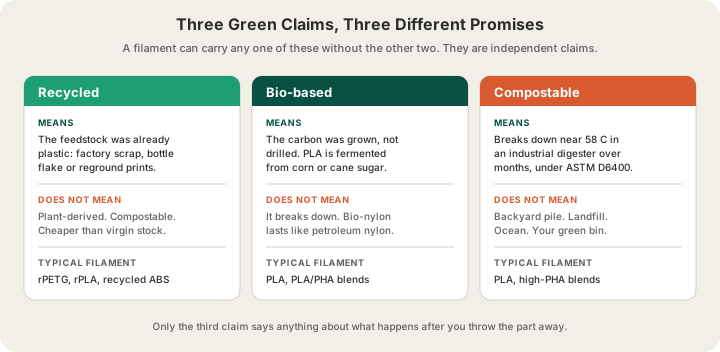
| Claim | What it actually means | What it does not mean | Typical filament |
|---|---|---|---|
| Recycled | The feedstock was already plastic and got diverted from waste | Plant-derived, compostable, or cheaper | rPETG, rPLA, recycled ABS |
| Bio-based | The carbon in the polymer was grown, not drilled | That it degrades — bio-based nylon lasts like petroleum nylon | PLA, PLA/PHA blends |
| Industrially compostable | Breaks down near 58 C in a managed digester over months (ASTM D6400) | Home compost, landfill, soil or seawater | PLA, high-PHA blends |
| Home compostable | Breaks down in a backyard pile at ambient temperature | Anything at printable stiffness — this is rare in filament | PHA-heavy blends only |
PLA Is Already the Bio-Based One
PLA is polylactic acid, polymerised from lactic acid that gets fermented out of plant sugar — corn starch in most of North America, sugarcane in much of the rest of the world. That is not a premium tier or a special order. It is the default material on our farm, priced at $0.12 per gram all-in, and it is what the majority of the jobs we run are printed in. If you have ordered a print from us in PLA, you have already bought a bio-based part. PLA vs PETG vs ABS vs ASA vs TPU: Which Filament to Choose covers how it compares mechanically to the four petroleum materials we stock alongside it. /docs/materials compares all five materials, their rates and what each is for.
What bio-based does not buy you is disappearance. PLA in a landfill is remarkably stable, because landfills are cold, dry and oxygen-poor — precisely the opposite of the conditions PLA needs to break down. The ASTM D6400 mark that appears on compostable packaging refers to an industrial digester holding roughly 58 C with controlled humidity for months on end. Those facilities exist, but most US municipalities do not run one, and almost none of them accept a rigid printed part alongside food scraps. The realistic end of life for a PLA print is a long, boring, inert one, or mechanical recycling if you can find a stream that takes it.
The honest environmental case for PLA is upstream, not downstream: grown carbon instead of drilled carbon, and a low melt temperature that draws less energy per gram than ABS or ASA. 3D Printing Environmental Impact: A Print's Carbon Footprint works through where the emissions in a print actually sit, and the answer is usually electricity rather than plastic — which is why the grid that powers a printer moves the number further than any spool swap would.
Where Recycled Filament Actually Comes From
"Recycled" covers four very different supply chains, and the difference between them determines whether the spool prints like virgin stock or like a lottery ticket.
- Post-industrial scrap. Purge, off-spec runs and extruder start-up waste from the filament factory itself. One known polymer, one known colour batch, one prior heat cycle, no contamination. This is the cleanest stream and behaves closest to virgin.
- Post-consumer bottle flake, which becomes rPETG. PET bottles are the best-collected plastic on the planet, so the feedstock genuinely exists at scale. Bottle-grade PET is not printer-grade PETG until it is compounded, glycol-modified and dried hard, so the good rPETG spools are a real industrial product rather than shredded bottles.
- Reground failed prints. This is the stream a print farm generates. Single material, often single colour, but already through one full melt, and mixed with whatever support material and brim was on the plate.
- Mixed post-consumer plastic. The cheapest and by far the riskiest. Unknown blend, unknown additives, unknown fillers, and the widest diameter variation of the four. Fine for a garden stake, wrong for anything that has to fit something else.
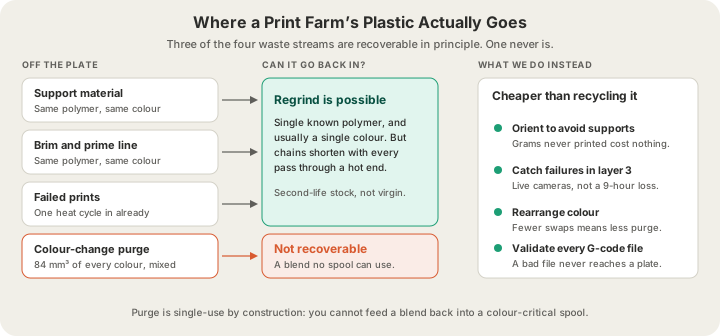
That last stream is worth dwelling on, because it explains why a farm cannot simply close its own loop. Colour-change purge is a blend of every filament that passed through the hot end — 84 mm3 of it at every single change, about 0.106 g of PLA. It is single-use by construction: you cannot feed a grey-brown blend back into a colour-critical spool. Purge Tower Waste: How Much Multi-Color Prints Throw Away has the full arithmetic, and the conclusion there is the same as here. The only way to deal with purge is to produce less of it.
What Changes When Plastic Goes Around Again
Every trip through an extruder is a heat cycle, and heat cycles shorten polymer chains. Lower molecular weight shows up as reduced impact toughness and slightly weaker layer bonds — the part is stiff enough but snaps instead of bending. Reclaimed feedstock also tends to arrive wet, because it has usually been sitting in a warehouse rather than a sealed bag with desiccant. Drying Filament: Why We Do It and When You Should Care covers what moisture does on the way out of the nozzle, and recycled stock earns a dry cycle more than virgin does.
| Property | Virgin stock | Recycled stock | Why |
|---|---|---|---|
| Diameter tolerance | Tight and consistent | Wider, more variation | Mixed feedstock melts less predictably |
| Colour repeatability | Batch to batch | Drifts; often dark to hide it | Input colours are blended together |
| Impact toughness | Baseline | Lower | Chain scission from a second heat cycle |
| Layer adhesion | Baseline | Slightly lower | Same shortened-chain effect |
| Moisture on arrival | Sealed and dry | Frequently wet | Reclaimed stock stores badly |
| Price | Baseline | Similar or higher | Sorting and drying cost more than fresh resin |
That last row is the one that surprises people. Recycled filament is routinely not cheaper. Collecting, sorting, shredding, washing, drying and re-extruding to a tolerance a printer can swallow is more labour than polymerising fresh resin, and the market prices it accordingly. Buy recycled stock for the reason it exists, which is diverting a waste stream, and treat any price saving as a bonus rather than the plan.
Where These Materials Belong — and Where They Do Not
Recycled filament is a good material with a narrower window than virgin, not a worse material. Match the window and it is genuinely the right pick.
- Good fits: internal jigs and fixtures, packing inserts and shipping cradles, early form studies and fit checks, planters and outdoor garden parts in rPETG, and large decorative pieces where grams dominate the price rather than detail.
- Poor fits: anything with a press fit or a tight tolerance; food-contact parts, because you cannot certify what you cannot trace — Food-Safe 3D Printing Filament: What's Actually True explains why the surface matters more than the polymer anyway; brand colour work, where batch drift is fatal; safety-relevant load-bearing parts, where the lower impact toughness is the whole problem; and fine-detail figurines, where inconsistent extrusion is visible from across a room.
| Material | Feedstock | $/g all-in | Recycled stock available? | Realistic end of life |
|---|---|---|---|---|
| PLA | Plant sugar (corn, cane) | $0.12 | Yes, as rPLA | Industrial compost or mechanical recycling |
| PETG | Petroleum, same family as bottle PET | $0.12 | Yes, as rPETG from bottle flake | Best mechanical recycling story of the five |
| ABS | Petroleum | $0.15 | Limited | Mechanically recyclable where a stream exists |
| TPU | Petroleum | $0.20 | Rare | Hard — elastomers resist regrinding |
| ASA | Petroleum | $0.15 | Rare | As ABS, where a stream exists |
What We Run in Austin, and Why
Our fleet is Bambu Lab H2S and P2S machines with four-tray AMS units, and our production stock is virgin PLA, PETG, ABS, TPU and ASA at the rates above. That is a deliberate choice rather than an oversight. Every quote we give comes from a real OrcaSlicer slice of your actual model where we can run one, and a per-gram price backed by a measured slice is a promise that the same file will produce the same part next month. Feedstock with drifting diameter and drifting colour breaks that promise, and it breaks it silently — you find out at the fit check, not at checkout. Full rates are on /pricing.
What we do instead is spend our effort on the grams that never needed to exist. Infill is set from geometry rather than a global default, so a display piece is not carrying a bracket's interior — 3D Printing Infill Explained: Patterns, Density, and Cost shows what each density band costs. Parts get oriented to avoid supports where the geometry allows. The G-code in every uploaded sliced plate is validated for unsafe temperatures and out-of-bounds moves before it reaches a machine. Live cameras and auto-eject mean a plate that is going wrong gets caught in the first layers instead of nine hours in, and a failure never repeats itself twelve times overnight. And the whole thing runs in Austin, Texas, and ships from there.
If your job specifically calls for recycled or bio-based stock — a sustainability-led product launch, a client requirement, a materials study — say so in the notes when you upload at /print. We will tell you honestly whether the geometry will tolerate the wider tolerance, and if it will not, we will say that too rather than ship you a part that misses its fit.
FAQ
Is recycled filament cheaper than virgin filament?
Usually not. Collecting, sorting, drying and re-extruding reclaimed plastic to a printable tolerance costs more labour than making fresh resin, so recycled spools tend to land at or above virgin prices. The reason to buy it is the diverted waste stream, not the invoice.
Is PLA biodegradable?
Only under industrial composting conditions: roughly 58 C, managed humidity, months of residence time. In a landfill, a drawer or a garden it is effectively inert, because none of those places supply the heat. It is plant-derived and it is recyclable in commercial facilities, but a PLA print left outdoors will deform in the sun long before it decomposes.
Can you print my order in recycled filament?
Ask us. Our standing stock is virgin material because slice-measured quotes depend on consistent diameter, but we will source a specific recycled or bio-based spool for a job when the geometry can tolerate it. Add a note when you upload at /print and we will come back with a straight answer either way.
Does recycled filament damage a printer?
Clean post-industrial and rPETG stock is no harder on a machine than virgin. Mixed post-consumer stock is a different story: unknown fillers can be abrasive enough to open up a brass nozzle, and inconsistent diameter is a jam risk in a bowden or AMS path. If you are running unknown regrind, run it on a machine you do not mind maintaining.
Price it now
What would yours cost?
A real example, priced by the same engine our checkout uses: a 50 g PLA part comes to $6.00 printed, plus $7.00 US shipping. Change the weight, material or quantity below and the price follows.
- 50 g × $0.12/g, per part
- $6.00
- Shipping
- $7.00
The same through the cart, where postage is free on orders of $49.50 or more.
Upload a file for the exact priceAn estimate from the weight you entered. The real quote weighs your file.
Two ways to your real price
Have a file?
Upload it. See the exact price.
Drop in your STL or 3MF. We slice it the way our printers will and price the grams it really uses. No account needed to see it.
Only an idea?
Describe it. We’ll email you a price.
No file, no problem. A few words on what it is and how big is plenty to start.
Or write to contact@x3dstudios.com