Carbon Footprint of a 3D Print: Solar-Powered Manufacturing
The carbon footprint of a typical desktop-sized 3D print is small — usually a few hundred grams of CO2e — and it comes from three places: the plastic itself, the electricity the printer draws, and shipping the finished part. For a 100 g PLA part printed on grid power in the US, a reasonable estimate is roughly 0.3–0.5 kg CO2e total. Electricity is usually the largest share, which is exactly why we built our 100-printer farm in Austin to run on solar: it removes the biggest slice of the footprint entirely.
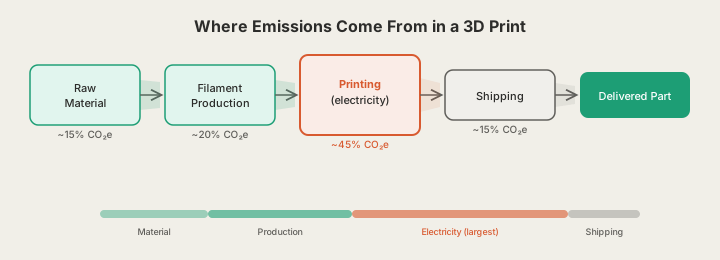
Where the Emissions Come From
1. The Material
PLA — the workhorse of FDM printing and our default material at $0.12/g all-in — is made from fermented plant starch rather than petroleum. Lifecycle assessments put PLA resin production at around 0.7 kg CO2e per kg of finished filament. Industry analyses report PLA production uses roughly 65% less energy and emits around 63% fewer greenhouse gases than comparable oil-based plastics.
A 100 g PLA part carries roughly 0.07–0.3 kg CO2e of embodied material emissions. Petroleum-based filaments like ABS or ASA carry more.
2. The Electricity
A desktop FDM printer draws 50–150 W averaged over a print. A 100 g part printing for six hours at ~100 W uses about 0.6 kWh. US generation averages about 0.37 kg of CO2 per kWh — making the electricity share about 0.22 kg CO2e on average grid power. On solar, that drops to approximately zero.
3. The Shipping
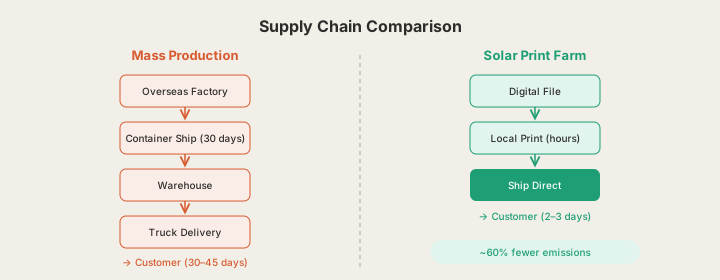
A small parcel moving a few hundred miles by ground freight adds well under 0.1 kg CO2e. Distributed manufacturing — printing close to the customer — avoids overseas container freight entirely.
The Footprint, Stage by Stage
| Stage | Grid-powered print | Solar-powered print |
|---|---|---|
| PLA filament (100 g) | ~0.07–0.3 kg CO2e | ~0.07–0.3 kg CO2e |
| Printing electricity (~0.6 kWh) | ~0.22 kg CO2e | ~0 kg CO2e |
| Domestic ground shipping | <0.1 kg CO2e | <0.1 kg CO2e |
| Estimated total | ~0.3–0.6 kg CO2e | ~0.1–0.4 kg CO2e |
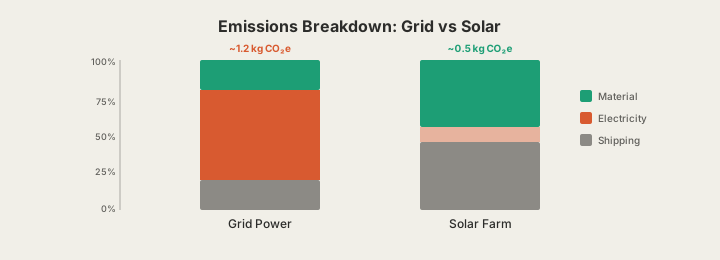
How a Solar Print Farm Changes the Math
A single hobbyist printer on solar is a nice gesture. A print farm running 100 printers on solar is a manufacturing decision. At farm scale, the electricity term is hundreds of kWh every day. Powering that with on-site solar removes the largest recurring emission source from every part shipped.
| Factor | Traditional mass production | Solar print farm |
|---|---|---|
| Tooling | Steel molds (energy-intensive) | None — digital file to printer |
| Material waste | Runners, sprues, overproduction | Near-net-shape; supports only |
| Inventory | Warehoused stock, often discarded | Printed on demand |
| Transport | Trans-ocean freight + trucking | Domestic ground shipping |
| Energy source | Regional grid mix | On-site solar |
FAQ
Is 3D printing bad for the environment?
It depends on scale and energy source. Per part at low volumes, 3D printing avoids tooling, overproduction, and long-distance freight. A solar-powered farm printing on demand is additive's strongest sustainability position.
How much CO2 does one 3D print produce?
For a typical 100 g PLA desktop object: 0.3–0.6 kg CO2e on grid power, dropping to 0.1–0.4 kg CO2e on solar.
Is PLA really better than ABS for the climate?
Generally, yes. PLA is plant-derived, with substantially lower production energy and greenhouse gas emissions than petroleum-based plastics like ABS.
Does solar power really cover a 100-printer farm?
Desktop FDM printers draw roughly 50–150 W each on average — a 100-printer fleet is well within a typical commercial solar installation's output in sun-rich Texas.
Ready to get started?
Upload a 3D model for instant pricing, or generate one with AI.