Food-Safe 3D Printing Filament: What's Actually True
Food-safe 3D printing filament exists, but almost nothing sold as "food-safe filament" produces a food-safe part on its own. Food safety is a property of a finished object in a specific use, not of a spool, and a printed object has to clear five separate links — base resin, pigment, hot end and machine, geometry, and cleaning — of which the spool label covers only the first. The practical answer: brief, dry contact with a cheap, replaceable part is fine; warm, wet, repeated contact is not, and no nozzle upgrade or epoxy coating changes that.
What Food-Safe Filament Actually Certifies
Food-contact approvals attach to a material, made by a named manufacturer, for a defined kind of contact. The definition includes what the food is (dry, watery, acidic, fatty), how long the contact lasts, and at what temperature. That is why the same polymer can be cleared for a dry-goods bin and not for a hot sauce bottle. The approval is issued at the point the material is made, under the process conditions the manufacturer declared. /docs/materials compares all five materials, their rates and what each is for.
The moment you push that material through a hot end you have manufactured a new article, on equipment nobody certified, in a room nobody inspected. The certificate does not travel with the plastic. Food-grade stainless steel is genuinely food grade; a knife welded out of it in a bike shop is not a certified knife. Filament works the same way.
The Five Links in the Chain
Here is the whole chain, in the order the plastic travels it. Two links you can genuinely fix by spending money and being careful. Three are properties of the FDM process itself and have no fix.
| Link | What goes wrong | Can you fix it? |
|---|---|---|
| Base resin | Some polymer grades carry additives never cleared for food contact | Yes — buy filament with documented resin data |
| Pigment and additives | Colourant, brighteners and slip agents are blended in after certification | Rarely — the blend is almost never disclosed |
| Hot end and machine | Nozzle alloys, residue from earlier filaments, open spools, an uninspected room | Partly — steel nozzle, dedicated spool, long purge |
| Geometry | Layer lines form a continuous crevice a sponge cannot reach into | No — this is what FDM is |
| Cleaning | The wash hot enough to sanitise the part is hot enough to deform it | No — PLA softens around 50°C |
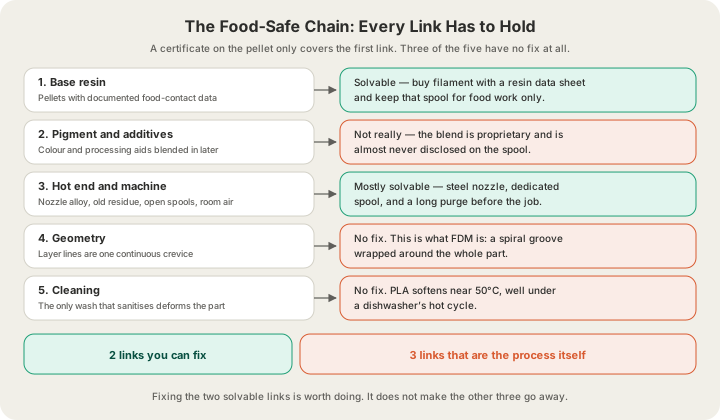
The nozzle link deserves its own sentence because it is the one people get half-right. Some brass alloys contain a small amount of lead to make them easier to machine, which is why a hardened-steel or stainless nozzle is a sensible upgrade for anything that will go near food. It is a real improvement, and it fixes exactly one link. A steel nozzle does not smooth the layer lines, does not document the pigment, and does not make the part washable.
Six Claims, Sorted
Most of the confusion online is a handful of claims repeated until they sound settled. Here is what is actually true about each.
| The claim | What's actually true |
|---|---|
| "The spool says food grade, so the print is food safe." | It covers the pellet the manufacturer made, under their process. Your part is a different article. |
| "A stainless nozzle makes it food safe." | Worth doing, and it fixes one link out of five. The crevices and the cleaning problem are untouched. |
| "Food-safe epoxy seals the layer lines." | It converts the question into whether the coating is fully cured and unbroken — unverifiable after the third wash. |
| "PETG is food safe because water bottles are PET." | Same polymer family, different additives, different process, and a moulded bottle has no layer lines. |
| "Extruding at 250°C sterilises the plastic." | It sterilises the filament crossing the nozzle. Not the bed, the air, your hands, or the surface it cools onto. |
| "0.05 mm layers are smooth enough to be safe." | Smaller crevices are still crevices, and finer layers price at 1.75× the standard rate for a problem they only shrink. |
Geometry Is the Link You Cannot Buy Your Way Out Of
Strip away the chemistry arguments and the real objection to a printed food surface is shape. An FDM part is a stack of extruded lines, and the boundary between every pair of them is a groove spiralling continuously around the object. It is not a texture. It is one connected channel with a mouth narrower than its interior, wrapped around the part hundreds of times — a good design for holding onto whatever gets in, and a bad one for cleaning.
Two features make it worse. The layer seam — the point where each loop of the outer wall starts and stops — leaves a vertical scar running up the side of the part, and a scar is a deeper crevice than a layer line. And a normal print is not solid: the interior is a sparse lattice with air in it, sealed under a few top layers, so if water finds a route in through a gap or a scratch it has nowhere to drain from and nowhere to dry. 3D Printing Infill Explained: Patterns, Density, and Cost covers what that interior actually looks like and why nobody prints solid by default.
Finer layers shrink the grooves without removing them, which is why the "just print at 0.1 mm" advice never quite closes the argument — 3D Printing Layer Height Explained: 0.08 vs 0.2 vs 0.28 walks through what layer height does and does not change. The honest summary is that a smooth moulded bowl has nowhere for anything to hide, and a printed bowl is composed almost entirely of hiding places.
What Is Genuinely Fine to Print for a Kitchen
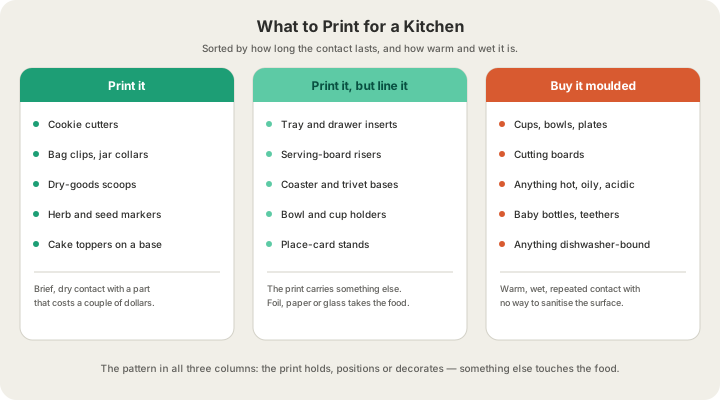
None of this means printing is useless in a kitchen. It means the print should be the thing that holds, positions, organises or decorates — and something else should be the surface food touches. Sorted three ways:
| Category | Examples | Why it works, or doesn't |
|---|---|---|
| Print it | Cookie cutters, bag clips, jar collars, dry scoops, herb markers | Contact is brief, dry, and the part costs a couple of dollars to replace |
| Print it, but line it | Tray inserts, board risers, coaster bases, cup and bowl holders | The print carries something food-safe; foil, paper or glass takes the contact |
| Buy it moulded | Cups, bowls, plates, cutting boards, baby bottles, anything hot or oily | Warm, wet, repeated contact with no way to sanitise the surface afterwards |
If You're Going to Do It Anyway
For a one-off — a mould for chocolate you will use twice, a scoop for a coffee tin — there is a best version of the compromise. It does not make the part food safe. It makes it the least bad printed part you can produce, and it treats the object as a consumable rather than as kitchenware.
- Print it in PETG, not PLA. PETG holds to about 75°C so it survives a hot hand-wash, where PLA softens near 50°C and deforms. Our full material comparison is in PLA vs PETG vs ABS vs ASA vs TPU: Which Filament to Choose.
- Use 0.1 mm layers. Shallower grooves are a real improvement, and on our farm that prices at 1.75× the per-gram rate — a 60 g insert goes from $7.20 to $12.60.
- Ask for heavy walls and a solid contact region. Five or more perimeters and 100% infill under the food-facing face means no internal voids for water to sit in.
- Keep supports and the layer seam off the contact face. Support scars and the seam are the deepest crevices on the part; put them on the underside.
- Skip the coating unless it is a display piece. A food-safe epoxy is only as good as its worst-cured spot, and you cannot inspect it once the part is in use.
- Hand wash cool, dry it fully, and retire it the moment the surface looks scratched or cloudy. Scratches are new crevices.
- Give it one job. A part that only ever touches dry flour is a much simpler risk than one that meets flour on Monday and chicken on Tuesday.
How We Handle Food-Adjacent Orders
We print a lot of kitchen-adjacent work and essentially none of it is a food-contact surface. Cookie cutters, jar collars, spice-rack inserts, cake-topper stands and drawer dividers all go through the farm regularly, and every one is a holder rather than a vessel. If your model is a bowl, a cup or a board we will print it — it is your part — but we will not call the result food safe, for the reasons above rather than anything about how we run the machines.
Practically: upload at /print and PETG prices at $0.12 per gram all-in, filament and normal machine time together, with a $1.00 minimum per part and billable weight rounded up to the whole gram. Quotes come from a real OrcaSlicer slice of your file rather than a bounding-box estimate, so a hollow scoop is not billed as a solid one. Shipping is $7 standard anywhere in the US, free over $49.50, or $15 express; the full rate card and bulk discounts are on /pricing. We accept STL and 3MF, including a plate you sliced yourself as .gcode.3mf; OBJ is not accepted, so convert first. The four-tray AMS on each machine handles the two-colour cookie cutter you were about to ask about. For the wider safety picture — fumes, materials and fire — Is 3D Printing Safe? Fumes, Materials, and Food Contact is the companion to this post.
FAQ
Is there such a thing as food-safe filament?
There are filaments made from resins that hold food-contact approvals, and that is a genuine, meaningful thing to buy. It is not the same as a food-safe print. The approval covers the material as the manufacturer produced it, under their conditions; the pigment blended in afterwards, your nozzle, your build plate and the layered surface you created are all outside it. Treat the label as one good link in a five-link chain rather than as a verdict on the finished object.
Does a food-safe epoxy coating actually work?
It works as long as the coating is completely cured, covers every square millimetre, and stays unbroken — and the trouble is that you cannot check any of those things once the part is in a drawer being used. A pinhole or a chip means food is now sitting against unsealed layer lines and against the coating's edge. For a decorative piece handled once, it is a reasonable step. For something washed weekly, it swaps a problem you understand for one you cannot see.
Are 3D printed cookie cutters safe to use?
Cookie cutters are the best case in the whole category and are generally fine. The contact is seconds long, the dough is cold, the part is cheap to replace, and whatever it touches gets baked afterwards. Print them in PETG if you plan to wash them in warm water, hand wash rather than putting them in a dishwasher, dry them properly, and replace them when the edges look scuffed. Do not use one on raw meat or leave it soaking.
Is PETG food safe for 3D printing?
Not by itself. PETG is the closest of the common filaments and the polymer family really is related to the one bottles are made from, which is why it is the right choice when you are going to print something kitchen-adjacent anyway. But a bottle is a moulded article with a glass-smooth surface and a documented additive package, and a printed part is neither. PETG improves the material and cleaning links. It does nothing about the geometry, which is the one that actually decides the answer.
Price it now
What would yours cost?
A real example, priced by the same engine our checkout uses: a 50 g PETG part comes to $6.00 printed, plus $7.00 US shipping. Change the weight, material or quantity below and the price follows.
- 50 g × $0.12/g, per part
- $6.00
- Shipping
- $7.00
The same through the cart, where postage is free on orders of $49.50 or more.
Upload a file for the exact priceAn estimate from the weight you entered. The real quote weighs your file.
Two ways to your real price
Have a file?
Upload it. See the exact price.
Drop in your STL or 3MF. We slice it the way our printers will and price the grams it really uses. No account needed to see it.
Only an idea?
Describe it. We’ll email you a price.
No file, no problem. A few words on what it is and how big is plenty to start.
Or write to contact@x3dstudios.com