Heat Resistant Filament: When PLA Melts in a Hot Car
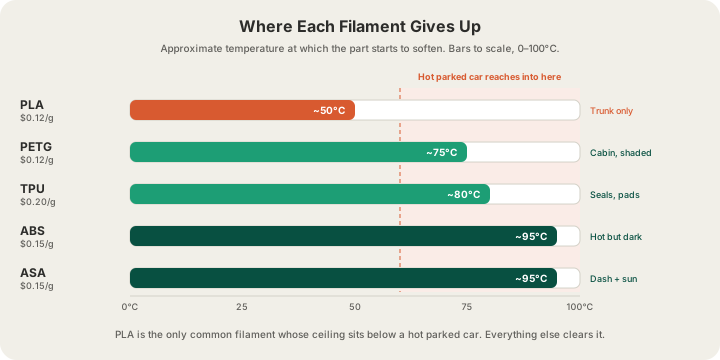
PLA does not melt in a hot car. It softens, which is worse, and the real fix is a heat resistant filament. Softening starts more than a hundred degrees below melting and leaves the part looking mostly intact while it quietly droops. PLA begins losing stiffness around 50°C, a temperature a closed car in summer sun clears without effort, so a printed phone mount sags off the vent and a dashboard bracket slumps overnight. Thicker walls or more infill will not save it; a material with a higher ceiling will: PETG for a shaded cabin, ABS or ASA for anything that sits in direct sun on a dashboard.
PLA Heat Resistance: Softening Is Not Melting
Every thermoplastic has two temperatures that matter. The melting point is where it becomes liquid and flows — that is why a nozzle runs 190 to 220°C to print PLA. Long before that comes the glass transition, the point where a rigid, glassy polymer turns rubbery and pliable. For PLA the glass transition sits in the 50 to 60°C range. The part is still solid. It is still the right shape when you look at it. It has simply stopped being stiff. /docs/materials compares all five materials, their rates and what each is for.
That is why the failures look so strange. People expect a puddle and find a phone mount whose arms have opened by three millimetres, or a cable clip that no longer grips. Nothing melted: the plastic went soft, gravity and the load did the rest, and the car cooled down and froze the new shape in place.
Load is the multiplier everyone forgets. An unloaded PLA trinket sitting on a hot dashboard often survives the summer looking fine. The same plastic under constant force deforms well below the temperature where it would sag under its own weight, because warm polymer creeps: it flows slowly and permanently under a load it would shrug off when cool. A snap-fit that is permanently sprung, a clamp tightened onto a vent blade, a bracket carrying a phone — those are the parts that fail first, and they fail on the second or third hot day, not the first.
Where in a Car the Heat Actually Is
A parked car is not one temperature. The cabin air heats up, but the surfaces in direct sun run considerably hotter than the air around them, and a dark dashboard behind glass is the hottest thing in the vehicle. A trunk, by contrast, is never in direct sun and behaves much more like a warm room. Matching the material to the specific spot in the car is cheaper than defaulting everything to the most expensive option.
| Where the part lives | Heat exposure | PLA verdict | What we would print it in |
|---|---|---|---|
| Dashboard or windshield, direct sun | Hottest place in the car, plus UV through glass | No | ASA |
| Air vent clip | Cabin air, plus sun on the dash beside it | No | ASA or ABS |
| Centre console, cupholder, cubby | Cabin air, shaded from direct sun | Marginal | PETG |
| Door pocket, glovebox insert | Cabin air, shaded | Marginal | PETG |
| Trunk organiser, boot liner clip | Warm, never in direct sun | Usually fine | PLA or PETG |
| Anything under the hood | Far past every FDM plastic we run | No | Not an FDM job |
The awkward row is "marginal". A shaded console part in PLA usually survives a mild climate and usually does not survive a Texas August, and the gap between those outcomes is one afternoon in a full parking lot. When a part is marginal, move up a material — PETG is the same rate per gram.
The Materials That Take Heat
There are four ways out of PLA. The three rigid ones cost between nothing and three cents more per gram at our all-in rate; flexible TPU costs eight cents more. The full strength, finish and printability comparison lives in PLA vs PETG vs ABS vs ASA vs TPU: Which Filament to Choose; this table reads the same five materials purely through the lens of a hot car.
| Material | Softens around | UV in sunlight | X3D rate | Where it belongs in a car |
|---|---|---|---|---|
| PLA | 50°C | Poor | $0.12/g | Trunk only, and only in the shade |
| PETG | 75°C | Good | $0.12/g | Console, glovebox, door pockets |
| TPU | 80°C | Good | $0.20/g | Gaskets, grips, anti-rattle pads |
| ABS | 95°C | Poor | $0.15/g | Hot but shaded: under seats, deep console |
| ASA | 95°C | Excellent | $0.15/g | Dashboard, vents, anything in the sun |
PETG is the default upgrade and the one most people should take. It buys roughly 25°C of headroom at the same rate per gram, it is tougher than PLA rather than more brittle, and it bends before it breaks — a useful failure mode for a clip that is going to be pulled on. It is the right answer for everything in the cabin that stays out of the sun.
ABS and ASA are the same heat class, and choosing between them is entirely a question of sunlight. ABS has excellent heat resistance and poor UV stability, so it belongs in hot places that are dark. ASA is ABS chemistry re-engineered for weather: identical heat performance, plus it does not yellow or go chalky under months of sun. A dashboard part is exposed to both heat and UV simultaneously, which is why ASA, tied with ABS as the dearest rigid option we run at $0.15 per gram, is the one material where paying up is unambiguously correct.
TPU deserves a mention because it solves a different problem. It stays functional to about 80°C and it is rubbery by design, so a soft part that gets softer is still doing its job. Anti-rattle pads, cupholder liners and gasket strips are all better in TPU than in any rigid material, and its hardness is tuned by infill density rather than by changing blend, so one spool covers everything from a firm bushing to a squashy pad.
Carbon Fibre Does Not Fix This
A common wrong turn is to reach for a carbon-fibre-filled filament when a part fails in the heat. CF fill raises stiffness and dimensional stability, and it genuinely helps parts that warp or flex. It does not move the glass transition, because that belongs to the base polymer, and CF-PLA is still PLA: a stiffer bracket that softens at exactly the same temperature. If heat is the problem, change the polymer, not the filler — Carbon Fiber Filament Explained: PETG-CF vs PLA-CF covers what CF is actually good for.
Design Changes That Buy You Headroom
Material is the big lever, but geometry decides how gracefully a part approaches its limit. These changes cost grams rather than cents per gram, and are worth making even after the material upgrade.
- Add wall perimeters before infill. More solid shell means more material carrying the load when the polymer goes soft, and walls buy more stiffness per gram than density does.
- Kill the standing load. A clip that is permanently sprung open will creep. Redesign it so it clamps only while you are installing it, or add a mechanical stop that takes the force instead of the plastic.
- Avoid long unsupported cantilevers. An arm sticking out horizontally is the shape most punished by softening, because gravity has maximum leverage on it. Add a gusset, or turn the arm into a triangle.
- Orient for the load, not the print time. Layer bonds are the weak axis and heat weakens them further — 3D Print Orientation for Strength: How to Orient a Model shows how to line the layers up with the force.
- Go lighter in colour. A black dashboard part absorbs far more of the sun that lands on it than a light grey one, and colour is free.
- Add clearance at mating faces. Warm plastic expands, and a press fit that was perfect in a cool garage will be tight at noon.
What the Upgrade Actually Costs
The reason people stay in PLA is usually a vague sense that the tough materials are expensive. They are not, because our rate is all-in per gram — filament and normal machine time together — and the gap between the cheapest and dearest rigid material is three cents. Take a typical phone dash mount at 42 grams, printed at standard 0.2 mm layers.
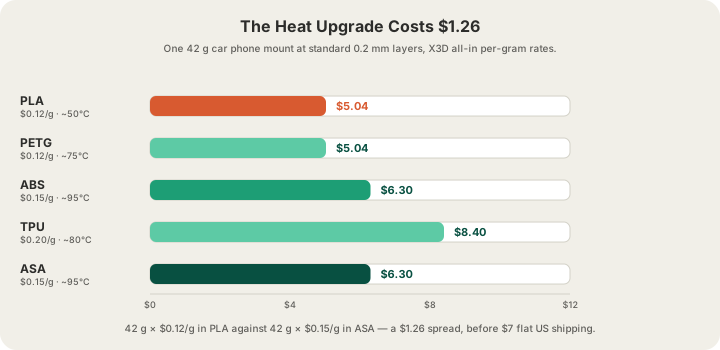
Just $1.26 separates the material that will fail this summer from the one that will not. Add $7 standard US shipping — free over $49.50, or $15 express — and the reprint you avoid pays for the upgrade several times over. Full rate card and the bulk discounts are on /pricing.
Ordering a Heat-Resistant Part From the Farm
Upload a model at /print, switch the material dropdown, and the price updates live so the ASA-versus-PLA question always has a number attached. Quotes come from a real OrcaSlicer slice of your file wherever possible rather than a bounding-box estimate, so the grams you pay for are the grams that go into the part. Billable weight rounds up to the whole gram and there is a $1.00 minimum per part, which is what keeps a $0.48 vent clip from costing more to invoice than to make.
We accept STL and 3MF, including a plate you sliced yourself as .gcode.3mf. OBJ is not accepted, so convert before you upload. The build volume on our Bambu Lab H2S machines is 340 × 320 × 340 mm, which covers any single automotive interior part, and the four-tray AMS units handle a contrasting insert if your mount needs one. We are in Austin, Texas, and normal print ships in 4–5 business days, or 1–2 with Priority print (10% of the items, at least $10). For the rest of the material-behaviour picture, Is 3D Printing Safe? Fumes, Materials, and Food Contact is the companion read.
FAQ
Will PLA melt in a car on a hot day?
No, and that is why the failure surprises people. Melting PLA takes nozzle temperatures near 200°C. What happens in a car is softening: around 50°C the plastic turns from glassy to rubbery, and any load on the part — its own weight, a spring preload, a phone hanging off it — slowly reshapes it. You get a warped, drooped, still-solid part rather than a puddle, and it usually happens on a hot day when the car is parked rather than while you are driving.
What is the best heat resistant filament for a car phone mount?
ASA. A phone mount is the worst case in the whole vehicle: it sits in the hottest zone, it is in direct sun through the windshield, and it carries a constant load. ASA gives you roughly 95°C of heat tolerance plus the UV stability that keeps it from going brittle and yellow after a few months behind glass. ABS matches the heat but not the sun, and PETG is a reasonable budget choice only if the mount lives low in the cabin and out of direct light.
Does annealing PLA make it heat resistant?
Heat-treating PLA does raise the temperature at which a part deforms, because it crystallises the polymer. It also shrinks and distorts the part while doing so, unevenly and in ways that depend on the geometry, so dimensions move and fits stop fitting. For a decorative object that nothing has to mate with, it is a fun experiment. For a bracket that has to bolt to something, changing material is far more predictable, and the difference between PLA and ASA is under two dollars on a typical part.
Can an ASA part live in a car all summer?
Yes. ASA is the material used for exterior automotive trim precisely because it holds up to sustained heat and UV together. The realistic limits are elsewhere: dark colours still run hotter than light ones, a part under permanent spring load will creep eventually in any thermoplastic, and nothing in the FDM range belongs under the hood, where temperatures leave every one of these materials behind.
Price it now
What would yours cost?
A real example, priced by the same engine our checkout uses: a 50 g PLA part comes to $6.00 printed, plus $7.00 US shipping. Change the weight, material or quantity below and the price follows.
- 50 g × $0.12/g, per part
- $6.00
- Shipping
- $7.00
The same through the cart, where postage is free on orders of $49.50 or more.
Upload a file for the exact priceAn estimate from the weight you entered. The real quote weighs your file.
Two ways to your real price
Have a file?
Upload it. See the exact price.
Drop in your STL or 3MF. We slice it the way our printers will and price the grams it really uses. No account needed to see it.
Only an idea?
Describe it. We’ll email you a price.
No file, no problem. A few words on what it is and how big is plenty to start.
Or write to contact@x3dstudios.com