20 AI Prompts for 3D Printing That Actually Print
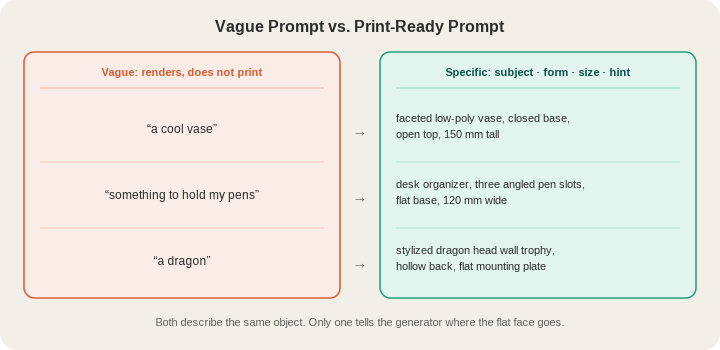
AI prompts for 3D printing that produce great prints all do the same thing: they name a physical object, describe its form and size, and say how it sits on the build plate. Vague, artistic prompts make pretty renders; concrete, geometric prompts make meshes that slice cleanly and survive the printer. Below are 20 prompts you can paste straight into the generator at /design, grouped by what they make, plus what they cost to print at our $0.12 per gram all-in PLA rate.
The Formula Behind Good AI Prompts for 3D Printing
Every prompt here has four parts: subject, form, dimension, print hint. "Hexagonal pencil cup" is the subject, "ribbed outer wall, open top" is the form, "90 mm tall" is the dimension, "flat base" is the print hint. Drop any one and the generator starts guessing, usually toward a floating, hollow-bottomed sculpture that looks great on screen and topples on a plate. Dimensions matter most: they anchor the proportions the model generates at, not the scale you type into a slicer later. How AI Text-to-3D Model Generation Works: Prompt to Mesh explains what happens in between. /docs/studio/design explains each generation mode, how long it takes and what it costs.
Desk and Workspace
Flat-bottomed, mostly vertical objects: the safest first generations, since nothing needs support material.
- "Desk organizer with three angled pen slots and a shallow phone tray, flat base, 120 mm wide"
- "Hexagonal pencil cup with a ribbed outer wall, open top, flat base, 90 mm tall"
- "Monitor riser leg with a solid flat foot and rounded shoulders, single piece, 90 mm tall"
- "Leaf-shaped cable clip with a flat underside and a c-shaped jaw, 30 mm long"
- "Business card holder with a 15 degree angled back and a thumb notch, 95 mm wide"
Home and Decor
Where AI beats modelling by hand: organic surfaces and repeating patterns that cost hours in CAD.
- "Faceted low-poly vase, closed base, open top, 150 mm tall, chunky triangular facets"
- "Wavy ribbed lampshade with an open top and bottom, 2 mm walls, 160 mm tall"
- "Voronoi-pattern tea light holder, cylindrical, flat base, 70 mm tall"
- "Art deco bookend, L-shaped, solid vertical face with a stepped fan detail, 120 mm tall"
- "Geometric wall hook with a 45 degree upswept arm and a flat screw tab, 80 mm long"
Figures, Toys, and Gifts
Ask for thick, fused limbs. Arms held away from the body become overhangs, and overhangs mean supports and scarring.
- "Low-poly sitting fox figurine, chunky facets, tail wrapped to the body, flat base, 80 mm tall"
- "Stylized dragon head wall trophy, hollow back, flat mounting plate, 120 mm tall"
- "Stackable ring puzzle, five nested tapered rings, 1 mm gap between rings, flat base"
- "Cartoon axolotl with thick limbs fused to the body, flat belly, 70 mm long"
- "Keychain tag with a raised initial panel and a 4 mm hole, flat back, 45 mm wide"
Functional Parts
AI is good at the body of a functional part and unreliable at the millimetre that makes it fit. Name the clearance, then check it.
- "Wall bracket with a 60 mm flat back plate, two countersunk holes, and a triangular gusset"
- "Tapered funnel, 40 mm mouth, 10 mm spout, 2 mm walls, no overhangs past 45 degrees"
- "Snap-fit lid for a 70 mm cylinder with a 0.3 mm clearance rim, flat top"
- "Tool handle grip with hexagonal ridges and a rounded cap end, 110 mm long"
- "Stackable seed tray with drainage slots and a 5 mm stacking lip, 100 mm square"
What These Prompts Cost to Print
Price is weight, not complexity: an intricate voronoi shade and a plain cylinder of the same mass cost the same. PLA is $0.12 per gram all-in, $1.00 minimum per part, $7 standard US shipping or $15 express. An order with a print in it that comes to under $25 in items pays a $5 small cart fee, which comes off at $25 or more.
| Prompt from this list | Typical weight | PLA price |
|---|---|---|
| Leaf-shaped cable clip | 6 g | $1.00 (minimum) |
| Hexagonal pencil cup | 45 g | $5.40 |
| Low-poly fox figurine | 60 g | $7.20 |
| Faceted low-poly vase | 110 g | $13.20 |
| Wavy ribbed lampshade | 180 g | $21.60 |
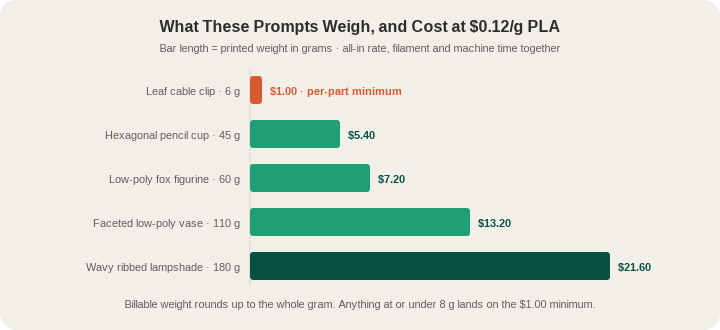
Those are estimates for the stated sizes. What you pay comes from a real OrcaSlicer slice of your model: a shade estimated at 180 g here may quote at 140 g once its walls are measured. Upload a generated file at /print for the real number.
FAQ
How do you make AI 3D models that print well?
Write one sentence, roughly 10 to 20 words, containing all four parts of the formula. Longer prompts add contradictions rather than detail: ask for "ornate baroque filigree" and "clean printable geometry" together and the generator averages them into mush.
Why does a good-looking generation fail to print?
Usually walls thinner than a nozzle can extrude, holes in the mesh, or an overhang the printer cannot bridge. Every model generated here runs automated validation and repair before it earns a Print Ready badge (see Watertight Meshes: Six Checks for a Print-Ready Model).
How big can a generated model be?
Up to 340 x 320 x 340 mm in one piece, the build volume of the Bambu Lab H2S machines on the farm. Larger objects get split and glued, so ask in the prompt for a shape that separates along a flat face.
Price it now
What would yours cost?
A real example, priced by the same engine our checkout uses: a 50 g PLA part comes to $6.00 printed, plus $7.00 US shipping and a $5.00 small cart fee, which comes off at $25.00 or more in items. Change the weight, material or quantity below and the price follows.
- 50 g × $0.12/g, per part
- $6.00
- Small cart fee
- +$5.00
- Shipping
- $7.00
Add $19.00 more in items and this fee comes off.
The same through the cart, where postage is free on orders of $49.50 or more.
Upload a file for the exact priceAn estimate from the weight you entered. The real quote weighs your file.
Two ways to your real price
Have a file?
Upload it. See the exact price.
Drop in your STL or 3MF. We slice it the way our printers will and price the grams it really uses. No account needed to see it.
Only an idea?
Describe it. We’ll email you a price.
No file, no problem. A few words on what it is and how big is plenty to start.
Or write to contact@x3dstudios.com