Best Text-to-3D Prompts: 25 Examples That Actually Print
The best text-to-3D prompts follow a simple formula: subject first, then form, material, style, and a print hint — for example, "desk organizer with three angled pen slots, honeycomb side panels, matte finish, solid base, no overhangs." Short, concrete, and physical. Below are 25 prompts built on that formula, organized by category, plus the structure behind them so you can write your own.
Everything here is tuned for prompts that produce printable geometry, not just pretty renders. If you want the full pipeline from prompt to delivered object, see our guide on turning an AI prompt into a real 3D print.
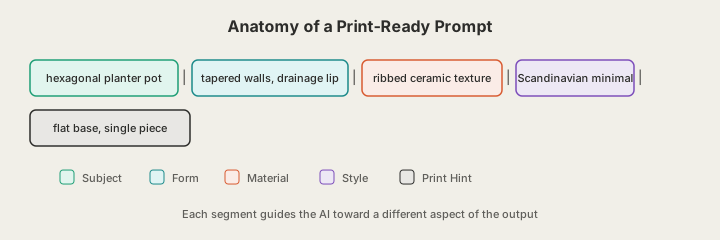
The Prompt Formula That Works
AI 3D generators weight the beginning of your prompt most heavily, so lead with the object itself. Then layer in detail in a consistent order:
| Slot | What it does | Example fragment |
|---|---|---|
| 1. Subject | Defines the core mesh | "hexagonal planter pot" |
| 2. Form / features | Shapes the geometry | "tapered walls, drainage lip" |
| 3. Material / texture | Drives surface detail | "ribbed ceramic texture" |
| 4. Style | Sets the aesthetic | "Scandinavian minimal" |
| 5. Print hint | Keeps it manufacturable | "flat base, single solid piece" |
25 Text-to-3D Prompts by Category
Desk and Home Objects (great first prints)
| # | Prompt |
|---|---|
| 1 | Desk organizer with three angled pen slots, honeycomb side panels, matte finish, solid flat base |
| 2 | Low-poly geometric vase, twisted facet pattern, single continuous wall, stable wide base |
| 3 | Minimalist phone stand, single-piece wedge design, cable slot at the base, smooth surface |
| 4 | Round coaster with wave relief pattern, raised rim edge, 4-inch diameter, flat underside |
| 5 | Hexagonal planter pot with drainage lip, ribbed texture, Scandinavian minimal style, tapered walls |
| 6 | Bookend shaped like a mountain ridge, solid triangular profile, flat back and bottom |
Characters and Creatures
| # | Prompt |
|---|---|
| 7 | Stylized baby dragon sitting upright, folded wings against body, chunky cartoon proportions, smooth scales |
| 8 | Low-poly fox figurine in sitting pose, tail wrapped around feet, faceted surfaces, solid base |
| 9 | Friendly robot character, rounded boxy body, short thick legs, antenna with ball tip, standing pose |
| 10 | Chibi knight with oversized helmet, sword resting point-down, sturdy stance, simplified armor plates |
| 11 | Sleeping cat curled into a loop, smooth simplified fur, flat contact underside |
| 12 | Cute octopus with six short curled tentacles forming the base, big rounded head, glossy look |
Functional Parts and Accessories
| # | Prompt |
|---|---|
| 13 | Wall hook with rounded J profile, two countersunk screw holes on flat backplate, thick reinforced curve |
| 14 | Headphone stand, arched single-piece design, wide oval base, smooth curves, no thin sections |
| 15 | Cable clip with open C-shape channel, flat adhesive-ready back, rounded edges |
| 16 | Stackable small parts tray, straight walls, interior dividers in a 2x3 grid, flat rim |
| 17 | Bag handle grip, cylindrical with finger grooves, open slot along one side, thick walls |
| 18 | Door stop wedge with ribbed top surface for grip, solid infill-friendly profile |
Decor, Gifts, and Display Pieces
| # | Prompt |
|---|---|
| 19 | Moon-phase wall plaque, circular relief design, raised crescent details, flat back for hanging |
| 20 | Chess knight piece, classical carved style, smooth mane curves, weighted wide base |
| 21 | Miniature lighthouse, spiral stripe relief, tapered cylinder, flat ground plane |
| 22 | Geometric ring dish, shallow faceted bowl, low rim, stable footprint |
| 23 | Art-deco picture frame, stepped border pattern, 4x6 opening, flat back panel |
| 24 | Tea light holder with cutout star pattern, cylindrical wall, solid base, openings wider than 3 mm |
| 25 | Desktop name plate with raised block letters, angled face, single solid body |
Vague vs. Specific: Why Most Prompts Fail
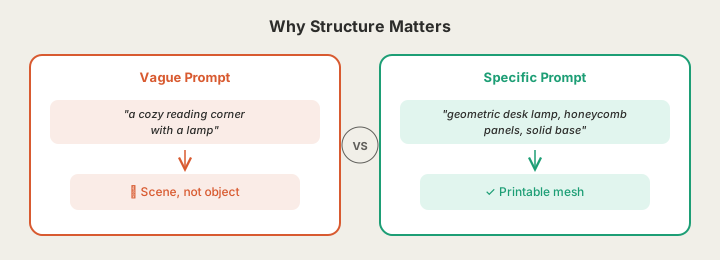
The most common failure mode is asking for a scene instead of an object. "A cozy reading corner with a lamp" gives the generator no single mesh to build. The second most common is requesting detail finer than a printer can resolve — individual hairs, embossed text under 2 mm, lace patterns.
Iterate: Treat the First Generation as a Draft
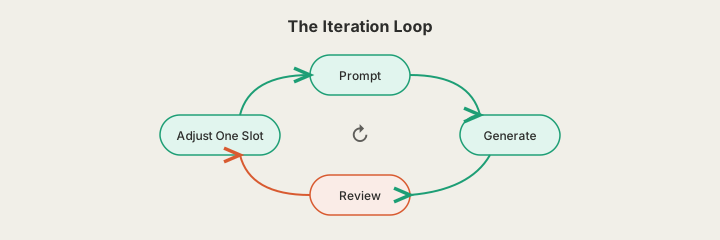
Strong results rarely come from a single attempt. The workflow that consistently works: generate from a short prompt, look at what the model got wrong, and edit one slot at a time. One variable per iteration tells you exactly what moved the result.
FAQ
How long should a text-to-3D prompt be?
Aim for one focused sentence — roughly 10 to 25 words. Long enough to fill the five slots (subject, form, material, style, print hint), short enough that the core object stays prominent.
Can I use the same prompts in any AI 3D generator?
The structure transfers, but results vary by tool — different generators handle texture, topology, and printability very differently.
Why does my generated model look good but fail to print?
Screen-ready and print-ready are different standards. Common culprits: non-watertight meshes, walls thinner than your nozzle can produce, and unsupported overhangs. Adding print hints to the prompt helps, but automated mesh validation is what actually catches these.
What's the best prompt style for miniatures?
Use "chunky," "stylized," or "low-poly" descriptors and avoid fine protrusions. Compact, grounded poses (sitting, curled, standing with support) print far more reliably at small scale than dynamic action poses.
Ready to get started?
Upload a 3D model for instant pricing, or generate one with AI.