Low Volume Manufacturing: Local Print Farm vs Overseas
For low volume manufacturing, a local print farm gets you finished parts in days with no tooling, no minimum order, and no freight, while overseas manufacturing gets you a lower unit price after you pay for a mold and wait months for the first shipment. For a typical small plastic part the crossover sits in the low thousands of units: below it, printing locally is both cheaper and faster; above it, the amortized tooling starts to win. This guide works through the real numbers, including the costs that never show up on an overseas quote.
Low Volume Manufacturing: Local vs Overseas at a Glance
The two options are not the same product with different postage. They have different cost structures, different failure modes, and different answers to the question every hardware team actually asks: how long until I can hold the part?
| Local print farm (Austin, TX) | Overseas contract manufacturing | |
|---|---|---|
| Tooling cost | $0: no mold, ever | Thousands per cavity, paid up front |
| Minimum order | 1 part, $1.00 minimum | Usually hundreds to thousands |
| First part in hand | Days | Months, after tooling and sampling |
| Design change cost | Re-upload the file | Re-cut or replace the tool |
| Freight | $7 flat US, free over $49.50 | Sea or air freight, plus duties and brokerage |
| Unit price at scale | Flat per gram | Falls steeply as volume rises |
| Communication | Same time zone, plain English | Overnight round trips |
| Best volume band | 1 to a few thousand | Tens of thousands and up |
Lead Time: Days Against Months
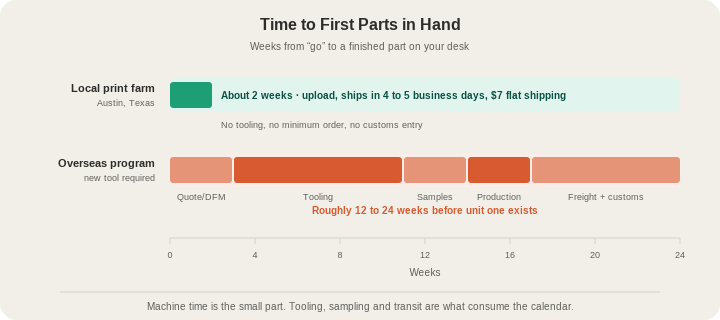
Ordering from our farm is measured in business days. You upload a model, the quote comes back from a real OrcaSlicer slice of your geometry rather than a bounding-box estimate, and it prints on Bambu Lab H2S and P2S machines: normal print ships in 4 to 5 business days, or 1 to 2 with Priority print (10% of the items, at least $10). Then it ships flat-rate. Start to finish, a first article is in your hands in about two weeks with standard postage, or inside a week with Priority print and express postage, the same rhythm covered in our guide to Rapid Prototyping with 3D Printing: From Idea to Part.
An overseas program is a sequence of waits stacked end to end: quoting and DFM back-and-forth, tool cutting, first-article samples, your approval, the production run itself, then sea freight and customs clearance. Any single stage can be reasonable and the total still lands months out. Air freight compresses the last leg at a cost that often erases the unit-price advantage on a small run. /docs/farm/bulk covers volume pricing and production runs.
The Cost Crossover, Worked Out
Take a 45 g PLA enclosure bracket, a realistic size for a mounting part, well inside our 340 x 320 x 340 mm build volume. At our all-in PLA rate of $0.12 per gram, covering both filament and normal machine time, that part prices at $5.40. Order ten or more and the 10% bulk discount takes it to $4.86 each. Any US order over $49.50 ships free, so at production quantities freight rounds to zero.
Now model the overseas side. Tooling costs vary enormously with geometry, but a straightforward single-cavity tool for a part this size is a four-figure commitment before unit one exists. Using an illustrative $8,000 tool and $0.90 per molded part, the landed unit cost depends entirely on how many parts you spread the tool across.
| Order size | Local print farm | Overseas (illustrative $8,000 tool + $0.90/part) | Cheaper option |
|---|---|---|---|
| 25 | $4.86 each · $122 total | $320.90 each · $8,023 total | Print farm |
| 250 | $4.86 each · $1,215 total | $32.90 each · $8,225 total | Print farm |
| 1,000 | $4.86 each · $4,860 total | $8.90 each · $8,900 total | Print farm |
| 2,500 | $4.86 each · $12,150 total | $4.10 each · $10,250 total | Overseas |
| 10,000 | $4.86 each · $48,600 total | $1.70 each · $17,000 total | Overseas |
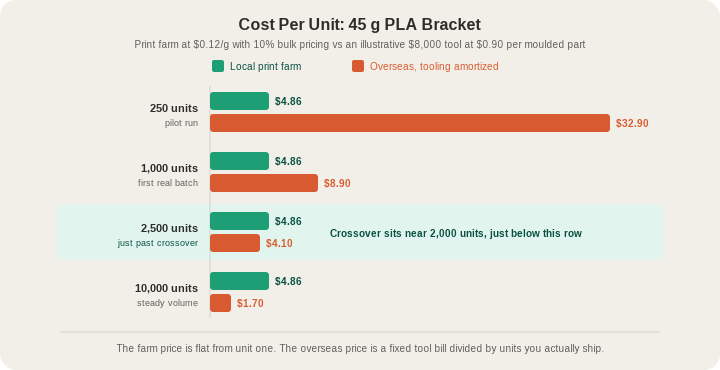
The crossover for this part lands near 2,000 units. That number moves with tool price and part weight, but the shape never changes: the farm's cost per unit is flat from the first part, and the overseas cost per unit is a fixed tooling bill divided by a volume you have to be confident about. The same curve, with injection molding as the specific comparison, is broken down in 3D Printing vs Injection Molding: The Cost Crossover.
Revisions Are Where Overseas Really Costs You
Almost no hardware product ships on revision one. Locally, a revision costs you nothing but the re-upload: change the CAD, drop a new STL or 3MF into /print, and the next slice reflects it. We accept STL and 3MF (a sliced plate as .gcode.3mf). Note that OBJ is not accepted, so export accordingly.
On a cut steel tool, a revision means welding and re-machining at best, and a new tool at worst, plus another sampling and approval cycle across a twelve-hour time difference. Teams that iterate overseas tend to freeze the design earlier than they should, which is how avoidable flaws end up in production.
The Costs That Are Not on the Quote
A per-piece price from an overseas supplier is a factory-gate number. Landed cost adds everything between that gate and your shelf, and it is routinely the difference between a good deal and a bad one.
- Freight: ocean or air, plus the trucking at both ends.
- Duties, tariffs and customs brokerage, which shift with policy and classification.
- Tooling deposits and payment terms that tie up cash months before revenue.
- Inventory carrying cost: a container arrives all at once whether you need it all at once or not.
- Sampling rounds, courier fees for samples, and third-party inspection if you use it.
- Rework or scrap on a batch you cannot inspect until it lands.
Local ordering collapses that list to one line. A US order ships for $7 standard, free over $49.50, or $15 express, with no customs entry, no broker, and no minimum quantity forcing you to buy a year of inventory to get a price.
Quality Control You Can Actually Watch
With an overseas run, quality control is a report someone else writes about a batch that already exists. Problems surface after the container clears customs, and the remedy is a negotiation.
Our farm inverts that. Every uploaded G-code file passes safety validation before it reaches a machine, live cameras on the printers let an operator catch a failing job early, and auto-eject clears finished plates so the next job starts without an operator. Orders move through stages you can see (placed, printed, shipped, delivered) rather than a status email at the end. If something is wrong on part three of 250, you find out on part three. More on the plumbing behind that in What Is a 3D Print Farm? How Ours Runs in Austin.
When Overseas Manufacturing Is Genuinely the Right Call
This is not an argument that offshore manufacturing is obsolete. It is the correct answer when the conditions actually hold:
- Volume is high and, more importantly, certain: tens of thousands of a design you are done changing.
- The part needs a process a print farm does not run: molded soft-touch overmoulding, die casting, blow moulding, stamped metal.
- The product is a full assembly with sourced electronics, fasteners, packaging and cables that a contract manufacturer will kit for you.
- Cosmetic requirements demand moulded surface finish and texture straight off the tool.
- Your margins genuinely depend on a per-unit cost only mass production reaches.
If two or more of those are true, plan the tool. If none are, the tool is a bet on a forecast.
The Hybrid Most Teams Should Run
The strongest position is not choosing. Prototype and iterate locally, launch on printed parts, and only cut a tool once real demand has told you the design and the volume. Printed bridge production funds the tooling instead of the other way round, and it keeps you shipping during the months the tool is being made.
| Stage | Where it belongs | Why |
|---|---|---|
| Concept and fit checks | Print farm | Days per loop, $1.00 minimum per part |
| Design validation, 10 to 100 units | Print farm | No tooling to obsolete when revision 4 lands |
| Launch and pre-orders | Print farm | Ship real product before committing capital |
| Bridge production during tooling | Print farm | Revenue continues while the tool is cut |
| Steady-state volume, design frozen | Overseas | Amortized tooling finally pays off |
| Spares, colourways, variants | Print farm | No second tool for a low-volume SKU |
Multi-colour variants are a good example of that last row. A 4-tray AMS lets us run colour changes inside a single job, so a limited colourway is a file change rather than a second tool, a second minimum order and a second container, the file being a project or a plate set up in those colours, since a plain STL runs in one filament.
What Ordering Locally Actually Looks Like
Upload an STL or 3MF file at /print. We slice it in OrcaSlicer, quote the real billable weight rounded up to the whole gram, and price it at the published per-gram rate: $0.12 for PLA, with a $1.00 minimum per part and 1.8x for premium 0.1 mm layers. Bulk pricing takes 5% off at five units and 10% at ten. Full rate card is on /pricing.
Parts up to 340 x 320 x 340 mm print in one piece; larger geometry has to be split into pieces you join, as covered in How to Split a 3D Model for Printing Big Parts. Normal print ships in 4 to 5 business days, or 1 to 2 with Priority print (10% of the items, at least $10).
FAQ
Is local manufacturing more expensive than overseas?
Per unit at high volume, yes. In total, often no. Local has no tooling bill, no minimum order, no freight beyond $7 flat US, and no duties. For the 45 g bracket above, 250 units cost about $1,215 printed locally versus roughly $8,225 landed overseas once the tool is paid for. Overseas only pulls ahead past about 2,000 units for that part.
What is the minimum order for a local print farm?
One part. Billing is by weight at $0.12 per gram for PLA with a $1.00 minimum per part, so a small bracket genuinely costs a few dollars. An order with a print in it that comes to under $25 in items pays a $5 small cart fee, which comes off at $25 or more. There is no tooling deposit and no quantity you must commit to in order to get the published rate.
How long does overseas manufacturing take compared with a print farm?
A printed order is typically in hand in about two weeks: 4 to 5 business days to ship at Normal print speed, plus transit, or 3 to 5 business days door to door with Priority print and express postage. An overseas program stacks quoting, tooling, sampling, production and sea freight, which commonly puts the first delivered units several months out even when every individual stage runs on schedule.
What is low volume manufacturing, and can a print farm do it?
Low volume manufacturing is a production run too small to justify a tool: from one part up to the low thousands. That is what a farm is for. Jobs are scheduled across a fleet of Bambu Lab H2S and P2S printers rather than queued behind one machine, with G-code validation, live cameras and auto-eject keeping them running unattended. Runs in the hundreds to low thousands are squarely in the band where the flat per-gram price beats amortized tooling.
Do I need different files for local versus overseas manufacturing?
Usually. We print from STL or 3MF (a sliced plate as .gcode.3mf), and OBJ is not accepted. A moulder will want solid CAD, typically STEP, because the toolmaker has to build a cavity from your geometry, not a surface mesh. Keep the parametric source file: exporting a mesh from CAD is easy, and recovering CAD from a mesh is not.
Price it now
What would yours cost?
A real example, priced by the same engine our checkout uses: a 50 g PLA part comes to $6.00 printed, plus $7.00 US shipping and a $5.00 small cart fee, which comes off at $25.00 or more in items. Change the weight, material or quantity below and the price follows.
- 50 g × $0.12/g, per part
- $6.00
- Small cart fee
- +$5.00
- Shipping
- $7.00
Add $19.00 more in items and this fee comes off.
The same through the cart, where postage is free on orders of $49.50 or more.
Upload a file for the exact priceAn estimate from the weight you entered. The real quote weighs your file.
Two ways to your real price
Have a file?
Upload it. See the exact price.
Drop in your STL or 3MF. We slice it the way our printers will and price the grams it really uses. No account needed to see it.
Only an idea?
Describe it. We’ll email you a price.
No file, no problem. A few words on what it is and how big is plenty to start.
Or write to contact@x3dstudios.com