3D Printing vs Injection Molding: The Real Cost Crossover for Production Runs
Injection molding produces parts for pennies — after you've paid $5,000–$50,000+ for the mold and waited 4–12 weeks for it to be machined. 3D printing costs more per part but starts at unit one with zero tooling. Somewhere between those curves is a crossover point, and in 2026 it sits much higher than most founders assume: for many consumer-scale plastic parts, printing wins up to roughly 5,000–10,000 units. Here's the math and the non-obvious factors that move it.
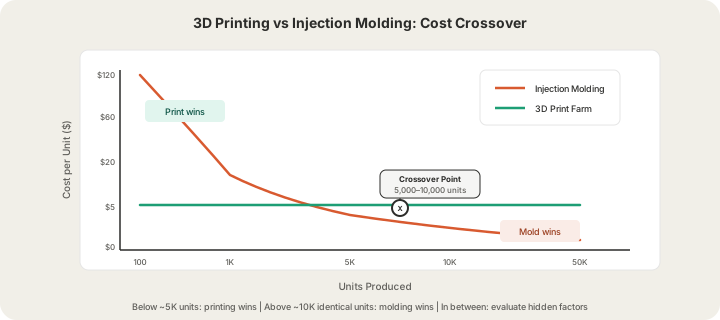
The Two Cost Curves
Injection molding: Total cost = mold ($5k–$50k+) + setup + units × (material + machine seconds). The per-unit cost is tiny; the entry fee is enormous. Design changes mean re-machining the mold — sometimes a new one.
Print farm FDM: Total cost = units × per-part print cost. No tooling, no setup fee, no minimum. A small PLA part at farm rates runs $1–5. The line is flat and starts at zero.
Worked Example
A 60g consumer product housing:
| Units | Injection Molding (incl. $12k mold) | Print Farm |
|---|---|---|
| 100 | ~$121/unit | ~$3/unit |
| 1,000 | ~$13.20/unit | ~$3/unit |
| 5,000 | ~$3.60/unit | ~$3/unit |
| 10,000 | ~$2.40/unit | ~$3/unit |
| 50,000 | ~$1.44/unit | ~$3/unit |
Crossover lands between 5,000 and 10,000 units. Below it, molding is burning money; above it, molding pulls away — if nothing about your product changes. That "if" is where the real story is.
The Factors the Spreadsheet Misses
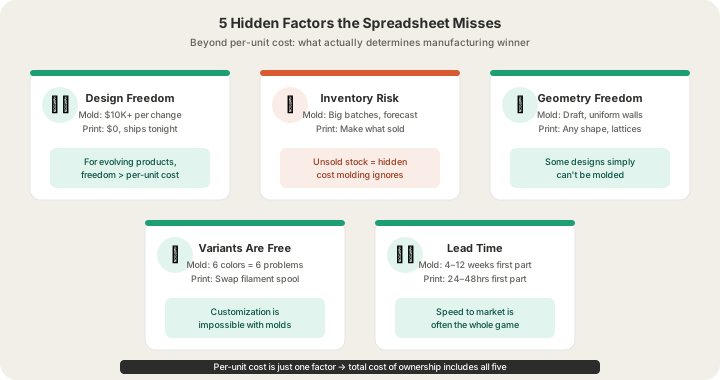
Design Freedom Has a Dollar Value
Mold tooling freezes your design. Find a flaw at unit 800, or want to iterate based on customer feedback? That's a four-or-five-figure re-tooling bill and weeks of delay. On a farm, v2 starts printing tonight for $0. For products still evolving — most products under 10k units — this dwarfs the per-unit delta.
Inventory Risk
Molding economics push you to order big batches, which means warehousing a demand forecast. Print-on-demand means making what actually sold. Unsold inventory is a cost line molding quotes never show.
Geometry Constraints
Molds require draft angles, uniform walls, and ejectable shapes. Printing doesn't — internal lattices, organic curves, and consolidated multi-part assemblies are free. Some products that print easily can't be molded without redesign.
Variants Are Free
Six colorways in molding = six production scheduling problems (or six molds). On a farm, color is a filament spool. Per-customer customization — names, sizes, configurations — is impossible with molds and trivial with printers.
Lead Time
Mold: 4–12 weeks before first article. Farm: first article in 24–48 hours, production batch days later. For validating a product in market, that speed difference is often the whole game.
When Molding Genuinely Wins
Honesty cuts both ways. Choose injection molding when you have:
- Proven demand above ~10k identical units
- A frozen design that won't change
- Need for molding-grade surface finish or materials FDM can't match
- Per-unit cost as the dominant constraint
Many products graduate from farm to mold — using printing to validate, then tooling up for scale. That's the system working.
The Hybrid Path
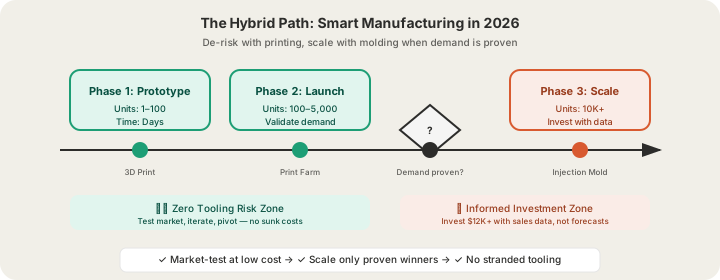
The pattern we see working in 2026: prototype and launch on the farm (units 1–5,000), tool up only after demand is proven. You carry zero tooling risk through the riskiest phase of the product, then make the molding investment with sales data instead of projections.
Our 100-printer solar farm is built for exactly this band — bulk runs with AI quality inspection on every part, 24–48hr turnaround, API submission for hardware teams, and white-label fulfillment.
FAQ
Is 3D printing cheaper than injection molding?
Below roughly 5,000–10,000 units for typical small plastic parts, yes — often dramatically, once tooling is amortized. Above that, molding wins on per-unit cost.
Can 3D printed parts match molded quality?
FDM shows layer lines; molding doesn't. For consumer goods this is increasingly accepted (and often styled as a feature). For optical-grade surfaces, molding still wins.
What's the minimum run for injection molding?
Practically, the mold cost sets it — most shops won't make sense below 1,000+ units. Printing has no minimum: order one part.
How fast can a print farm deliver 1,000 units?
Depends on part size; with 100 high-speed printers running 24/7, small parts ship in days, not the months a mold takes.
Ready to get started?
Upload a 3D model for instant pricing, or generate one with AI.