Bulk 3D Printing Services Compared: Print Farms vs Industrial Bureaus (2026)
Need 500 units of a part? You have three fundamentally different options: an industrial service bureau (Xometry, Protolabs, Shapeways), a dedicated FDM print farm (Slant 3D and a new generation of farms, including ours), or building your own farm. The right choice depends on volume, part requirements, and whether you need an API in the loop. Here's the honest comparison.
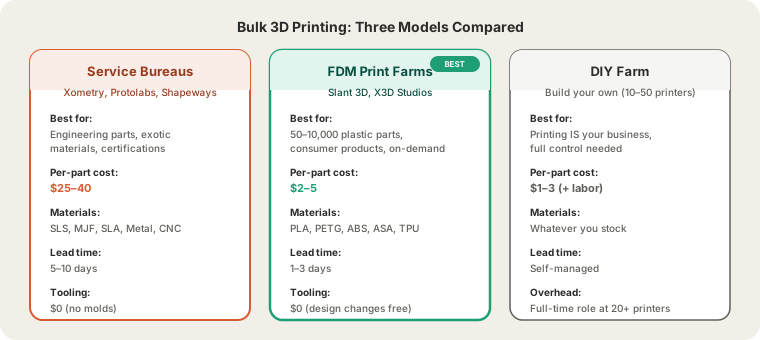
The Three Models
Industrial Service Bureaus
Xometry, Protolabs, Stratasys Direct, and Shapeways aggregate many manufacturing processes — SLS, MJF, SLA, metal printing, CNC. They excel at engineering-grade parts with tight tolerances and exotic materials.
Strengths: material breadth, tolerances, certifications, large-format parts. Weaknesses: cost — industrial processes carry industrial pricing. A simple plastic enclosure that costs $3 to FDM-print can quote at $30+ on SLS. For consumer products in standard plastics, you're paying for capabilities you don't use.
FDM Print Farms
A print farm is hundreds of consumer-grade, high-speed printers (typically Bambu Lab) running as one automated system. Slant 3D popularized the model as an "injection molding alternative." Per-part economics approach material cost because the farm runs autonomously — no operator per machine, automated plate swaps, and modern CoreXY printers running at 500mm/s.
Strengths: per-part price, no tooling cost, design changes between batches are free, 24–48hr turnaround. Weaknesses: FDM materials only (PLA/PETG/ABS/ASA/TPU), visible layer lines, parts limited to printer build volume.
DIY Farm
Buying 10–50 printers yourself makes sense only if printing is your business. Farm management software, failure handling, maintenance, and filament logistics consume a full-time role well before 20 printers.
When a Print Farm Wins
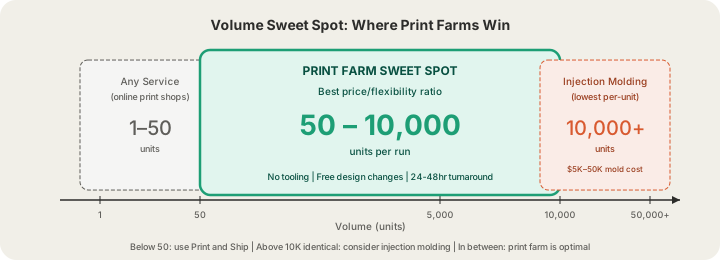
The print farm sweet spot: runs of 50–10,000 consumer-grade plastic parts. Below 50, any online service works (our Print & Ship handles one-offs). Above ~10,000 identical units, injection molding's per-unit cost finally beats printing.
Within that band, farms beat bureaus on price and beat molding on flexibility:
- No tooling: molds cost $5,000–$50,000+ and lock your design. Farms charge $0 to change the design tomorrow.
- Inventory-free: print on demand against actual orders instead of warehousing a forecast.
- Variant-friendly: 10 colorways or per-customer customization costs nothing extra.
Cost Comparison: Real Numbers
| Factor | Service Bureau (SLS) | FDM Print Farm | Injection Molding |
|---|---|---|---|
| Per-part cost (small enclosure) | $25–40 | $2–5 | $0.50–1.50 |
| Tooling / setup | $0 | $0 | $5,000–50,000+ |
| Minimum order | 1 unit | 1 unit (bulk from 50) | 500–1,000 units |
| Design change cost | $0 | $0 | New mold ($$$) |
| Lead time | 5–10 days | 1–3 days | 4–8 weeks (mold) |
| Materials | SLS/MJF/SLA/Metal | PLA/PETG/ABS/ASA/TPU | Any thermoplastic |
| Surface finish | Excellent | Good (layer lines) | Excellent |
| Breakeven vs molding | N/A | ~10,000 units | 10,000+ units |
What to Evaluate in a Bulk 3D Printing Partner
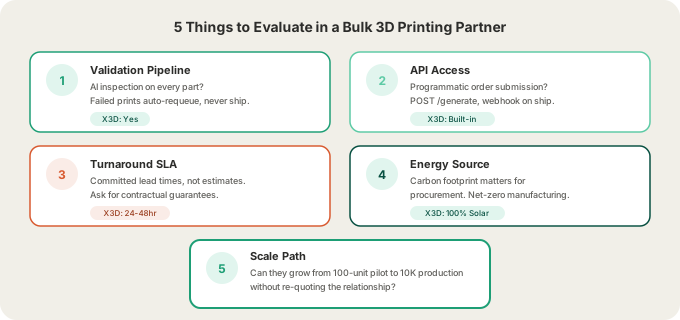
- Validation pipeline — does every part get checked, or do you receive whatever came off the bed? Our farm runs AI-powered inspection; failed prints re-queue automatically and never ship.
- API access — if you're a hardware team or marketplace, programmatic submission matters: POST /generate, webhook on ship. Our API is built for this, including white-label fulfillment.
- Turnaround SLA — ask for committed lead times, not estimates. Ours: most orders ship in 24–48 hours.
- Energy source — manufacturing carbon footprint is increasingly a procurement question. Our farm is 100% solar-powered — net-zero manufacturing isn't a premium add-on, it's the default.
- Scale path — can the partner grow from your 100-unit pilot to 10,000-unit production without re-quoting the relationship?
Where X3D's Farm Fits
We're building a 100-printer solar-powered farm in Austin, Texas — Bambu Lab CoreXY machines, AMS multi-material, automated plate swaps, AI quality inspection. Phase 1 (10 printers) is live and fulfilling store and custom print orders today; full capacity plus the public API launches with early access open now.
What's different: the farm is connected to an AI design studio, so the pipeline runs prompt → validated model → production in one system. For white-label partners, that means your customers can generate custom products and you never touch a printer.
FAQ
How much does bulk 3D printing cost per part?
For FDM at farm scale, think weight times a transparent rate — small parts run $1–6 each at PLA's $0.12/g all-in. Get a per-unit quote rather than extrapolating single-print prices.
Is FDM quality good enough for consumer products?
Modern 0.2mm/0.1mm prints with quality inspection ship as finished consumer goods — our entire store is farm-printed FDM.
What's the minimum order for bulk pricing?
Varies by service; ours starts at Enterprise/dedicated-capacity conversations for sustained volume. One-offs and small batches go through Print & Ship with no minimum.
Ready to get started?
Upload a 3D model for instant pricing, or generate one with AI.