Rapid Prototyping with 3D Printing: Idea to Part in 48 Hours
Rapid prototyping with 3D printing means holding a physical, testable part within 48 hours of having the idea — no tooling, no quoting emails, no minimum order beyond $3. On our solar-powered print farm the standard path looks like this: generate or upload a model in under an hour, get an instant size-based price, print the same day on a 500mm/s machine, pass AI inspection, and ship with photos inside 24–48 hours. Here is that timeline hour by hour, and the math on why iterating this way costs less than one tooling change order.
The 48-Hour Timeline, Hour by Hour
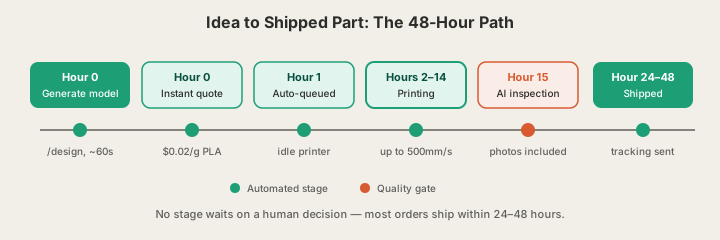
| Hour | Stage | What happens |
|---|---|---|
| 0 | Model | Type a prompt at /design (30–60s to a print-ready mesh) or upload your own file at /print |
| 0 | Quote | Instant, size-based: weight × $0.12/g all-in for PLA, no sales call |
| 1–2 | Queue | Scheduling software assigns the job to the next idle printer |
| 2–14 | Bambu Lab CoreXY machines at up to 500mm/s; most prototypes finish in 2–8 hours | |
| ~15 | Inspect | AI-powered inspection checks the part; failures re-queue automatically |
| 24–48 | Ship | Packed with inspection photos, tracking number sent |
Hour 0: You Don't Need CAD to Start
The slowest part of prototyping used to be making the model. The AI generator at x3dstudios.com/design turns a text description or a reference photo into a print-ready mesh in 30–60 seconds, with mesh validation built in so the geometry is watertight before it reaches a slicer. If you already work in CAD, skip straight to the upload at x3dstudios.com/print. Either way, signup comes with 5 free generation credits.
Hours 2–14: The Farm Does the Work
A typical prototype — a 40–80 gram bracket, enclosure, or stand — prints in 2–8 hours at farm speeds. Because the queue spans the whole fleet, your job never waits behind someone's 30-hour print on a single machine.
Hours 24–48: You See the Part Before the Box Does
Every order ships with inspection photos, which matters more for prototyping than it sounds. If the photos show your snap fit printed clean, you can start revising the next version before the package clears the sorting facility — effectively overlapping your design loop with transit time.
Why Farms Beat Traditional Service Bureaus
Traditional prototyping bureaus quote in days because a human reviews every file, and they batch jobs to keep expensive industrial machines full. That model made sense when a single SLS machine cost $300,000; it makes no sense when the fleet is dozens of fast, identical FDM printers. A print farm removes both bottlenecks.
- No quoting delay — pricing is computed from the mesh the moment you upload, not after an engineer reviews it
- Instant capacity — dozens of identical printers means an idle machine is always minutes away, not days
- Automated scheduling — software packs jobs onto plates and machines; nights and weekends count as production time
- In-line quality — AI inspection catches failures before shipping instead of after your deadline
Iteration Economics: 3 Revisions for Under $35
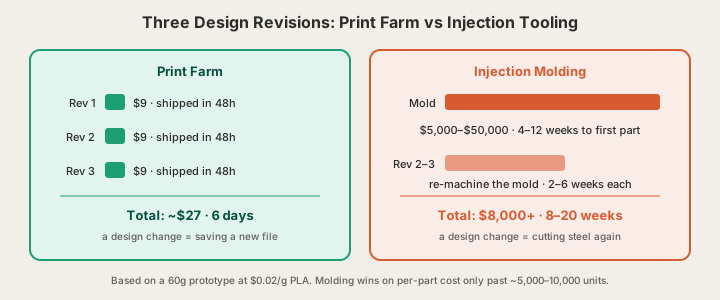
A 60-gram prototype costs $7.20 in PLA at $0.12/g all-in — call it $14 shipped as a small order. Run three full design revisions and you've spent about $43 and six calendar days. The traditional alternative is cutting a mold: $5,000–$50,000 upfront, 4–12 weeks to first part, and every design change means re-machining steel. The cheapest mistake you will ever make in product development is one caught in a $14 print.
Picking a Prototype Material
| Material | Price/gram | Prototype role |
|---|---|---|
| PLA | $0.12 | Draft and form checks — stiff, accurate, tied with PETG for cheapest |
| PETG | $0.12 | Functional testing — tougher, slightly flexible, handles 70°C |
| TPU | $0.13 | Flexible parts — gaskets, grips, living hinges |
| ASA | $0.14 | Outdoor prototypes — UV stable, weather resistant |
Print rev 1 in PLA even if the final product needs something tougher — you're checking shape and fit, and PLA is the most dimensionally accurate FDM material. Switch to PETG or ASA once the geometry is proven and you start abuse-testing.
A Real Loop: Phone Stand in Three Revisions
Monday morning: prompt the AI generator for an adjustable phone stand with a cable slot, order rev 1 in PLA for $7. Wednesday: it arrives; the viewing angle is too upright and the cable slot pinches a braided cable. Tweak the prompt, order rev 2. Friday: angle is right, but a heavy phone tips it backward — widen the base 20mm for rev 3. The following Tuesday: rev 3 passes every test. Total: $25, eight days, three physical parts you actually held and used at your desk. A tooling-first process would still be waiting on its first quote — and the first render you approved on a screen would still be hiding the tipping problem no render ever shows.
When to Move from Prototype to Production
The nice thing about prototyping on a farm is that production is the same button. From 50 parts up, bulk discounts kick in and the fleet parallelizes the run — no re-quoting, no design-for-molding rework, no new supplier. Injection molding only starts winning on per-part cost somewhere past 5,000–10,000 units; below that, staying on the farm keeps every future design change free.
There's a sustainability angle too: our entire farm runs on 100% solar power, so a week of rapid iteration doesn't carry the carbon load it would at a grid-powered facility. Prototype fast without the footprint guilt.
FAQ
How fast can I get a 3D printed prototype?
Most orders ship within 24–48 hours of checkout. Add transit time — 4–6 business days on standard US shipping, or 2–3 on express — and you're testing a physical part within the week or so.
How much does a 3D printed prototype cost?
PLA is $0.12 per gram all-in with a $1 minimum order. A palm-sized prototype runs $2–11 plus shipping; a full three-revision loop typically stays under $45.
Is FDM strong enough for functional prototypes?
Yes, for most consumer-product loads. PETG and ASA handle real mechanical use; orient layer lines along the stress direction and add wall perimeters for load-bearing features. Reserve doubt for high-heat and safety-critical parts.
Do I need CAD software to prototype?
No. The AI generator turns a text description or an image into a print-ready model in about a minute, and you get 5 free credits on signup. CAD becomes worth learning when you need exact dimensioned features like threads and bearing bores.
What quantity counts as a bulk order?
Bulk discounts start at 50 parts. Because the fleet prints a run in parallel, 50 copies of a proven prototype don't take 50 times as long — they take roughly one print cycle across the farm.
Ready to get started?
Upload a 3D model for instant pricing, or generate one with AI.