3D Printing for Small Business: Sell Products, Zero Inventory
3D printing lets a small business sell physical products with zero inventory: you design an item once, list it in your shop, and a print farm manufactures each unit only after a customer has paid. No minimum order quantity, no warehouse, no cash locked up in stock. At our farm's all-in rate of $0.12 per gram of PLA, a typical 30-gram product costs about $3.60 printed and inspected, and sells for $15–25 — margins dropshipping can't touch, on a product nobody else can source.
The Zero-Inventory Model
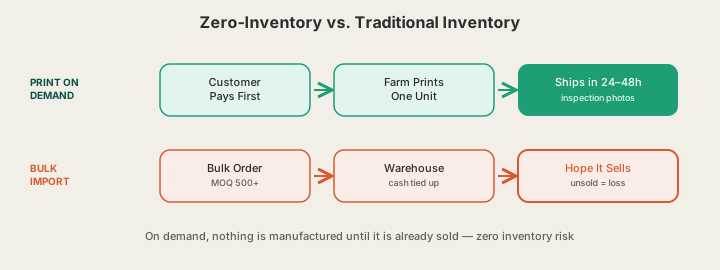
Design Once, Sell Forever
A digital product catalog is just a folder of 3D files. Each listing costs you nothing to keep "in stock" because stock doesn't exist — the file becomes a physical object only when an order comes in. Your catalog can hold 5 products or 500 with identical carrying cost: zero.
Why No MOQ Changes Everything
Injection molding demands thousands of units before the math works. A print farm profitably makes quantity one — our minimum order is $3. That means you can test 20 product ideas with real customers, kill the 17 that don't sell, and scale the 3 that do. Traditional retail forces you to bet on winners before you have any data; print on demand lets the market pick them for you.
What Actually Sells
- Personalized items — name plaques, cake toppers, pet tags. Personalization is the one thing mass production structurally cannot do.
- Niche accessories — a stand for one specific headphone model, mounts for a particular camera rig. Small markets that big brands ignore.
- Replacement parts — discontinued knobs, clips, and brackets for appliances people don't want to throw away.
- Hobby-specific gear — tabletop terrain, cable combs, plant labels, dice trays. Communities with money and specific taste.
- Desk and home goods — organizers, lamps, planters with a distinctive design language.
Most sellers doing this today run an Etsy or Shopify storefront. The store handles discovery and payment; the farm handles atoms. You never touch a printer.
Notice the common thread: every category wins on specificity, not price. You will never beat a mass-produced phone stand on cost, and you don't need to — you sell the phone stand for one specific phone, in the buyer's team colors, with their gamertag on the base. Specific beats cheap in every one of these niches.
Unit Economics: A Worked Example
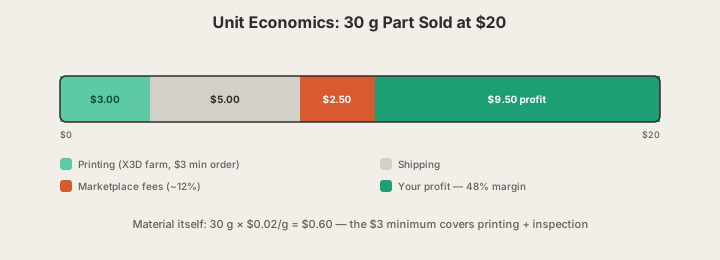
Take a 30-gram desk organizer sold at $20. The print is 30 grams at $0.12 per gram all-in — $3.60 for the full printed, inspected part. Add $7 domestic shipping and roughly 12% in marketplace fees ($2.50), and you keep $6.90 per unit: a 35% margin. Price the same part at $25, which personalized items easily command, and profit climbs to $11.40 — 46%.
Compare that with the same $20 sale as a dropshipper: a $12–14 landed cost on a commodity product leaves $2–4 after fees, and a dozen competitors undercut you next month because they source from the identical supplier. The 3D printed version has no identical supplier — the design is yours.
Margins vs. Dropshipping
| 3D print on demand | Dropshipping | Bulk import | |
|---|---|---|---|
| Upfront cash | $0 | $0 | $2,000–10,000 |
| Typical margin | 30–50% | 10–25% | 50–70% if it sells |
| Delivery to customer | 24–48h production, US ship | 2–4 weeks overseas | Fast, from your garage |
| Product uniqueness | Yours alone | Same as 1,000 other stores | Limited |
| Inventory risk | None | None | All of it |
A Print Farm Is Your Factory
The workflow is simple: when an order lands in your shop, you submit the file at x3dstudios.com/print, pick material and color, and pay per gram. Our solar-powered farm of Bambu Lab CoreXY printers — running at up to 500mm/s — prints it, an inspection with photos confirms quality, and it ships within 24–48 hours. Materials cover PLA, PETG, ABS, ASA, and TPU, so the same catalog can span decor, outdoor parts, and flexible goods. For sellers ready to automate order forwarding entirely, our farm's REST API is opening up through early access at x3dstudios.com/farm.
The Per-Order Workflow
- Customer pays in your shop — you've already collected $15–25 before anything is manufactured.
- You submit the file and options to the farm; the price is computed from weight, so there's no quoting delay.
- The farm prints, inspects, and photographs the part within 24–48 hours.
- It ships — to you for branded packaging, or onward to the customer if speed matters more.
Start This Weekend — No CAD Required
The historical blocker for non-engineers was design. That's gone: the AI generator at x3dstudios.com/design turns a text prompt or reference image into a validated, print-ready model in about 30–60 seconds, and signup includes 5 free credits. Every model is checked for printability before you see it, so what you list is what customers receive — no CAD skills, no mesh repair, no slicer.
- Day 1: Generate 10–15 product concepts with AI. Pick a niche you actually belong to — you already know what that community wants.
- Day 2: Order samples of your best 3–4 designs. At $3–5 for a typical small part, validating your whole first line costs less than $25.
- Day 3: Set up the Etsy or Shopify listing shells while samples are in production; they arrive in days, you photograph them, and you're live.
Sustainability Is a Selling Point
Every part from our farm is made with 100% solar power, and on-demand production means nothing is manufactured that hasn't already been sold — no overruns headed for a landfill. "Solar-made in the USA, printed only when you order" is a genuine differentiator on a marketplace full of anonymous imports, and buyers increasingly filter for it.
FAQ
How much does it cost to start a 3D printing business without a printer?
Under $50. Design generation starts with 5 free credits, sample prints start at our $1 minimum order, and marketplace listings cost cents. Your first real expense is ordering samples of the designs you like.
Do I need to own a 3D printer?
No. The farm prints per order and ships in 24–48 hours with inspection photos. Owning printers means owning maintenance, failures, and idle time — leave that to a facility built for it.
What profit margins are realistic?
30–50% after printing, shipping, and marketplace fees for typical $15–25 products. Personalized items run higher because customization commands premium pricing on near-identical costs.
What materials should my products use?
PLA covers most indoor decor and accessories and prints with the cleanest finish. Choose PETG or ASA for outdoor or high-heat items like car accessories and garden gear, and TPU for flexible products like phone bumpers. All five materials — PLA, PETG, ABS, ASA, TPU — run on the same farm.
How do I handle a sudden spike in orders?
That's the farm's problem, not yours — jobs are scheduled across the fleet automatically. Bulk discounts at 50+ parts also mean a spike improves your margin rather than breaking your operation.
Ready to get started?
Upload a 3D model for instant pricing, or generate one with AI.