3D Printed Lamps: From AI-Generated Design to Ambient Light
A 3D printed lamp is one of the few home objects where printing beats every other manufacturing method outright: translucent PLA diffuses LED light into a soft, even glow, and a printer builds geometry — voronoi webs, twisted spirals, lithophane panels — that no injection mold could ever release. This guide covers the four lamp styles that print best, three AI prompts that generate a shade you can actually print, and the wall-thickness and safety numbers that separate a glowing shade from a plastic lump.
Why 3D Printing Is Perfect for Lamps
Geometry a Mold Can't Make
Injection molds have one hard rule: the part must pull out of the tool. That kills undercuts, internal lattices, enclosed webs, and interlocked shells — exactly the shapes that make light interesting. A printer builds layer by layer, so a voronoi sphere with 200 organic openings costs the same to make as a plain cylinder. Complexity is free; that changes what a lamp can look like.
Translucent PLA Is a Natural Diffuser
At 1.2–2mm wall thickness, translucent and even standard white PLA passes 30–60% of LED light while scattering it evenly — the same job a frosted glass shade does, at a fraction of the weight. The layer lines add a fine horizontal texture that reads as intentional, like ribbed glass. Warm-white LEDs (2700–3000K) flatter PLA best; cool white makes the plastic look clinical.
Four Lamp Styles That Print Beautifully
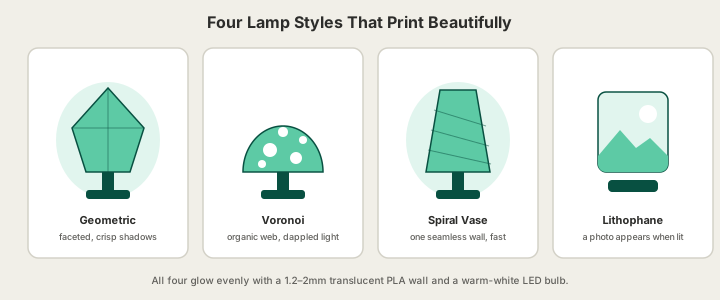
| Style | Print time (est.) | Character | Difficulty |
|---|---|---|---|
| Geometric / faceted | 4–8 hrs | Modern, crisp shadows | Easy |
| Voronoi / organic web | 6–12 hrs | Dappled, sculptural light | Medium |
| Spiral vase mode | 2–4 hrs | Seamless, soft column of glow | Easy |
| Lithophane | 5–10 hrs | A photo appears when lit | Medium |
Geometric and Voronoi Shades
Faceted low-poly shades throw clean, architectural shadows and print with zero supports if you keep overhangs under 45 degrees. Voronoi shells scatter light through hundreds of openings — the printed web needs struts at least 2mm thick to survive handling, and the open structure runs cooler around the bulb.
Spiral Vase Mode
Vase mode prints the whole shade as one continuous single-wall spiral: no seams, no retractions, and the fastest print time of any style. Two spiralized perimeters with a 0.6mm nozzle lands right around 1.2mm — the bottom of the glow sweet spot — which is why vase-mode lamps look lit from within.
Lithophanes
A lithophane converts a photo into varying wall thickness — thin areas glow bright, thick areas stay dark — so the image only appears when the lamp is on. Printed in white PLA at 0.8–3mm thickness range, it's the single best photo gift a printer can make.
Design Your Own with an AI Prompt
You don't need to model a lamp shade in CAD. The AI generator at x3dstudios.com/design turns a text description into a print-ready mesh in 30–60 seconds, with mesh validation built in — and you get 5 free credits at signup. Prompts that describe one clear form, a surface pattern, and an open bottom work best. Three that generate printable shades reliably:
- A faceted low-poly table lamp shade, tapered cylinder, diamond facet pattern, open bottom, smooth interior
- An organic voronoi lamp shade shaped like a rounded sea urchin, thick connected web, open at the base
- A twisted spiral lamp shade, vertical ribs rotating 90 degrees from base to top, gently tapered
If the first generation isn't quite right, regenerate with one adjective changed — swap faceted for fluted, or add a taper — rather than rewriting the whole prompt. Small prompt edits move the design predictably; full rewrites start over from scratch.
Materials, Wall Thickness, and Safety
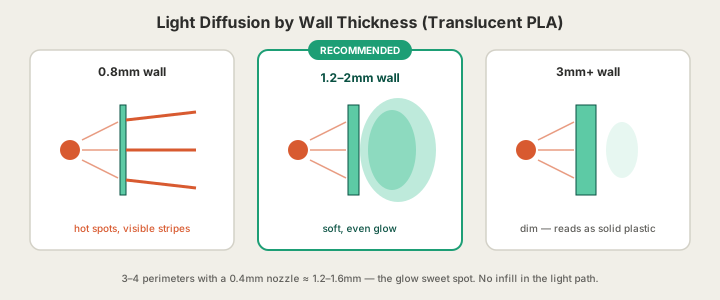
The wall is the whole design. Under 1mm you see the bulb filament as a hot spot and every infill line as a stripe; over 2.5mm the shade goes dim and reads as solid plastic. Aim for 1.2–2mm of clean perimeter walls with no infill in the light path — three to four perimeters with a standard 0.4mm nozzle lands you there.
Material picks are simple: PLA for anything indoors — best translucency, best accuracy, and tied with PETG as the cheapest at $0.12/g all-in. Choose PETG if the lamp lives somewhere warm like a car-facing windowsill, and ASA for outdoor fixtures where UV would chalk PLA within a season.
Use Real Lamp Hardware
Print the shade; buy the electrics. A UL-listed cord set with an E26 socket costs under $15 and removes every wiring question from the project. The printed part should only ever be the diffuser and the structure around it — never the socket, never anything that touches house current directly.
Or Buy One Made from Sunlight
The lamps in our store at x3dstudios.com/store are printed to order on the farm — nothing sits in a warehouse — and the farm runs on 100% solar power. We like the loop on that: sunlight charges the panels, the panels drive the Bambu Lab printers, the printers make the lamp, and the lamp gives the light back at night. A lamp made from sunlight, literally. Every order ships in 24–48 hours with inspection photos, so you see your exact shade — layer lines, glow test and all — before it arrives.
Care Tips
- Dust with a dry microfiber cloth or a blast of air — no solvents, which haze PLA
- Keep PLA shades out of direct summer window sun and parked cars; sustained heat over 50°C can warp them
- If a shade yellows after years of use, print a replacement — the file outlives the part
FAQ
Are 3D printed lamps safe?
Yes, with an LED bulb. A 6–10W LED runs warm to the touch, far below PLA's 60°C softening point. The unsafe combination is any printed shade with an incandescent or halogen bulb — never do that.
What's the best material for a 3D printed lamp shade?
Translucent or white PLA. It diffuses light most evenly, prints most accurately, and costs as little as anything we print. PETG for warm locations, ASA for outdoor fixtures.
Can I print a shade for a lamp base I already own?
Usually. Measure your harp or socket ring diameter, then scale the model so the opening clears it — standard US shade fitters are common sizes, and a printed adapter ring covers the rest.
How much does a 3D printed lamp shade cost?
A 150–250g shade runs $18–30 printed and inspected at our $0.12/g all-in PLA rate, before shipping — still a fraction of what comparable custom shades sell for.
Ready to get started?
Upload a 3D model for instant pricing, or generate one with AI.