The 3D Printing API: Manufacturing as Code Is Coming
A 3D printing API lets software order physical parts: POST an STL file to an endpoint, get back a price and a job ID, and a few days later a manufactured part arrives — no quote requests, no email threads, no human in the loop. It does for manufacturing what Stripe did for payments and AWS did for servers: it turns a capital-intensive capability into an HTTP call.
Manufacturing as Infrastructure
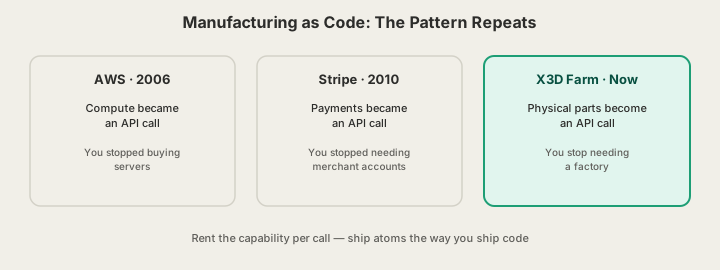
Before AWS, launching software meant buying servers. Before Stripe, accepting a credit card meant a merchant account and weeks of paperwork. Each time, an entire capability collapsed into an API key, and a generation of companies got built on top. Manufacturing is one of the last major capabilities still gated behind human quoting, phone calls, and factory relationships. A print farm behind a REST API removes that gate.
The consequences follow the same script, too. When servers became rentable per hour, thousands of products launched that never could have justified a data center. When manufacturing becomes callable per part, products launch that never could have justified tooling — a run of 25 brackets, a one-off robot gripper, a personalized product line with a customer base of 400 people.
Who Actually Needs This
"Software ordering parts" sounds abstract until you look at who is already forcing spreadsheets and email threads to do this job today:
- Hardware startups running CI for physical parts — merge a CAD change and the pipeline automatically orders the new revision, like a nightly build that ships a bracket.
- Marketplaces and apps selling custom or personalized products without owning a single machine — the API is their white-label fulfillment layer.
- Robotics teams and labs that break parts constantly: a gripper finger snaps at 2 a.m. and a script has already reordered it before standup.
- Agentic AI systems — an agent that designs a part can now order its own prototype, inspect the photos, and iterate.
What the API Does
Submit and Price
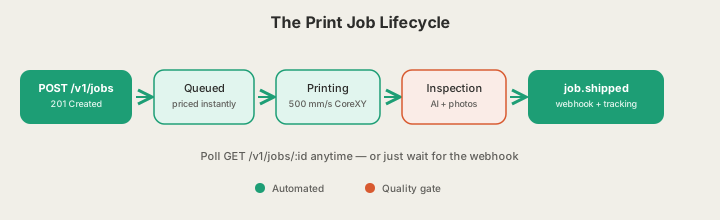
You POST a model file — STL, OBJ, or 3MF — with material, color, and quantity. Because pricing on a print farm is a pure function of weight and material, the quote comes back in the same response: no callback, no salesperson, no "we'll get back to you within 3 business days." If the mesh has printability problems, the API rejects it with specifics instead of letting a doomed job into the queue.
Track, Webhook, Receive
From there the job moves through queued, printing, and inspection, and you can poll its status or — the sane option — register a webhook. When the part clears AI inspection and ships, a job.shipped event arrives with tracking and inspection photos. Here's the shape of it:
curl -X POST https://api.x3dstudios.com/v1/jobs \
  -H "Authorization: Bearer x3d_live_..." \
  -F "[email protected]" \
  -F 'options={"material":"PETG","color":"black","quantity":25}'

# Response
{
  "id": "job_8Kf3q",
  "status": "queued",
  "quote": { "unit_price": 2.00, "total": 50.00, "currency": "USD" },
  "estimated_ship": "2026-07-05",
  "webhook_events": ["job.printing", "job.shipped"]
}Why Print Farms Make This Possible
Traditional job shops can't offer this because quoting requires human judgment: setup, tooling, machining strategy. A print farm is deterministic. Price is a function of weight, material, and quantity — $0.12 per gram of PLA all-in, $1 minimum on our farm. Scheduling is software packing jobs onto idle printers, and quality control is AI inspection with photos. When nothing in the pipeline requires a human decision, nothing requires a sales cycle.
| Traditional job shop | API-driven print farm | |
|---|---|---|
| Quote | 1–5 days, human-generated | Instant, computed |
| Minimum order | $100+ setup fees | $3 |
| Placing an order | Email thread and a PO | One POST request |
| Status updates | Call and ask | Webhooks |
| Scaling 10x | Renegotiate the contract | Change the quantity field |
The economics compound with scale, too: the same request that orders 1 part orders 500, bulk discounts apply automatically at 50+ parts, and jobs spread across the fleet in parallel instead of waiting on a single machine. Capacity planning becomes the farm's problem — you just send requests.
X3D Farm API: Early Access Now
Our farm buildout runs in phases: 10 printers are live today, the 50-printer phase is in progress, and the 100-printer phase ships the public API and white-label partnerships, with multi-site farms after that. The API is Phase 3's headline feature, and we're onboarding early access partners now at x3dstudios.com/farm — hardware teams and marketplaces who want programmatic printing before it's public, on a fleet of Bambu Lab CoreXY machines running up to 500mm/s, entirely on solar.
Solar matters more here than it sounds. An API that orders physical goods will get called a lot — that's the point — and every job carries the energy cost of the machines that ran it. On our farm that energy is generated on-site, so scaling API volume doesn't scale grid draw, and every part your software orders ships with a net-zero manufacturing footprint you can put in front of your own customers.
The Agentic Future
Here's where it gets interesting. Our AI generator already turns a text prompt into a validated, print-ready model in about 30–60 seconds. Put that beside a print API and the loop closes: an AI agent designs a part, submits it, receives inspection photos via webhook, critiques its own work, and orders revision two. Design and manufacturing both become steps in a program. When software can ship atoms, "hardware iteration speed" starts to look like software iteration speed — and the teams who wire this up first will simply out-cycle everyone else.
This isn't speculative infrastructure hunting for a use case. Agent frameworks already browse, code, and buy things; a documented endpoint that accepts a mesh and returns a tracking number is all that's missing for them to build in the physical world.
FAQ
What is a 3D printing API?
A REST interface for ordering physical parts programmatically: submit a 3D file, receive an instant price and job ID, track status, and get a webhook when the part ships. Manufacturing without a human quoting step.
How much does printing through the API cost?
Same pricing as the rest of the farm: $0.12 per gram all-in for PLA with a $1 minimum order, and bulk discounts from 50 parts. The quote comes back in the API response before you commit.
What materials are supported?
PLA, PETG, ABS, ASA, and TPU — specified per job in the options payload, covering rigid, outdoor-rated, and flexible parts.
How do I know a shipped part is good without seeing it?
Every part passes AI-powered inspection before packing, and the shipping webhook includes inspection photos — the same photos human customers get. Failed prints are re-queued automatically and never ship.
When will the API be publicly available?
Public launch lands with Phase 3 of the farm buildout, the 100-printer milestone. Early access is open now for teams that want in before that.
Ready to get started?
Upload a 3D model for instant pricing, or generate one with AI.