3D Printing Materials Guide: Choose in 60 Seconds
The fastest 3D printing materials guide is three questions, not three hours: does the part live outdoors, does it get hot, and does it need to bend? If the answer to all three is no (and for most parts it is), print it in PLA at $0.12 per gram all-in and stop thinking about it. Every other filament on the menu exists to fix one specific thing PLA cannot do. The rigid fixes cost at most three cents more per gram; flexibility costs eight. Here is the 60-second version, then the reasoning behind each branch.
3D Printing Materials Guide: The 60-Second Version
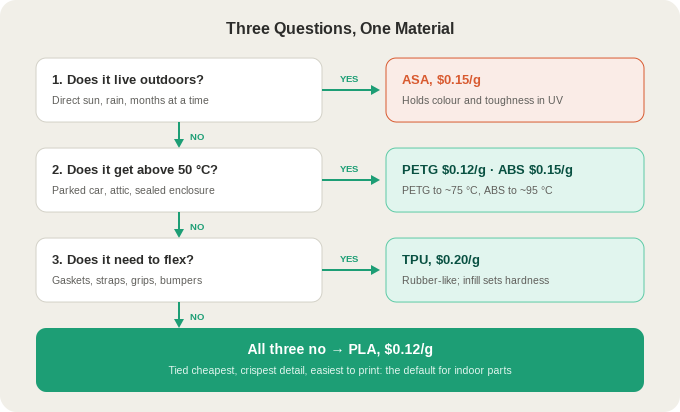
- Will it sit in sunlight or weather for months? Yes → ASA, $0.15/g.
- Will it ever get above about 50 °C (a parked car, an attic, a lamp housing)? Yes → PETG at $0.12/g, or ABS at $0.15/g if it also takes impacts.
- Does it need to squish, stretch, or seal? Yes → TPU, from $0.25/g.
- All three no? PLA, $0.12/g. Tied cheapest, cleanest surface, easiest to print.
That is the whole decision for the overwhelming majority of parts we print. The order matters: run the questions top to bottom and take the first yes, because a part that lives on a fence post in Austin is an outdoor part first and a heat question second. If two answers come back yes and they disagree (an outdoor part that also has to flex, say), tell us at checkout and we will talk through it, because that combination usually wants TPU with a UV-tolerant colour rather than a compromise material. /docs/materials compares all five materials, their rates and what each is for.
Question 1: Does It Live Outdoors?
Sunlight is the single most destructive thing you can do to a printed part, and it does not announce itself. UV breaks polymer chains at the surface; the part keeps its shape for weeks, then goes chalky, loses colour, and snaps at a load it used to shrug off. PLA is the worst offender here and ABS is barely better: ABS yellows and embrittles in months of direct Texas sun despite being tough enough for a car interior.
ASA is the answer, and it is the only reason ASA exists. It is chemically close to ABS with the butadiene swapped for an acrylate rubber that does not care about UV, so it holds colour and impact strength through years outside. At $0.15/g it shares our top rigid rate with ABS (only TPU costs more), but an outdoor bracket you print once beats a PLA one you print four times. We walk through the difference in detail in ASA vs ABS Filament for Outdoor Parts.
One nuance: shade is not the same as outdoors. A part on a covered porch, a garage shelf, or a north-facing window sill sees very little direct UV, and PETG handles that environment fine at $0.12/g while also shrugging off rain and hose spray. Save ASA for parts that take full sun.
Question 2: How Hot Does It Get?
PLA starts to soften around 50 °C. That number sounds high until you remember that a car dashboard in an Austin July clears it before lunch, and so does an enclosed light fixture, a laptop vent, and the top of a 3D printer. A softened PLA part does not melt into a puddle. It sags under its own weight or under whatever it is holding, and it never comes back. We have a whole post on that failure mode at Heat Resistant Filament: When PLA Melts in a Hot Car.
| Material | Softens around | Typical home for it |
|---|---|---|
| PLA | 50 °C | Desk, shelf, anything indoors and out of the sun |
| PETG | 75 °C | Kitchen, garage, sealed outdoor housings |
| TPU | 80 °C | Grips and gaskets that also see warmth |
| ABS | 95 °C | Car interiors, tool handles, impact-heavy parts |
| ASA | 95 °C | Full-sun outdoor parts, roof and fence hardware |
PETG is the sensible first step up. It buys you 25 °C of headroom, real water resistance, and a slight give that makes it forgiving in snap fits, at the same price per gram. Go to ABS only when the part also takes hits: ABS is the tougher of the two under impact, which is why it is still the default in automotive interiors. Both are cheaper than a redesign.
Question 3: Does It Need to Flex?
TPU is the only genuinely flexible material we run, and it behaves less like a plastic than like a firm rubber. Gaskets, phone bumpers, watch straps, drawer liners, cable strain reliefs, feet for things that slide: all TPU, from $0.25/g. It is also the one material where infill density is a design control rather than a cost control: the same bumper at 15% infill squishes like foam and at 60% feels nearly rigid, which is a hardness dial you get for free. See TPU Filament for 3D Printing: Shore Hardness Explained for the full picture on printing, bonding, and designing with it.
Where people go wrong with TPU is asking it to do rigid work. It will not hold a threaded insert under torque, it will not stay flat as a large panel, and it makes a poor bracket. If the part needs to be stiff and only bend a little (a living hinge on a box lid, a clip that flexes once per use), PETG is usually the better call.
A Comparison of 3D Printing Materials, All Five Side by Side
| Material | Rate (all-in) | Outdoor / UV | Feel | Pick it when |
|---|---|---|---|---|
| PLA | $0.12/g | Poor | Rigid, crisp detail | Indoors, out of the sun (the default) |
| PETG | $0.12/g | Good | Rigid with slight give | Water, warmth, snap fits, shaded outdoors |
| ABS | $0.15/g | Poor | Rigid, tough | Heat plus impact: car interiors, handles |
| ASA | $0.15/g | Excellent | Rigid, tough | Full sun, years outside |
| TPU | from $0.25/g | Good | Rubber-like | Anything that has to squish, stretch, or seal |
Those rates are all-in: filament and normal machine time in one number, with no separate setup charge. If you want the long-form comparison with strength, print quality, and eco profile, that lives in PLA vs PETG vs ABS vs ASA vs TPU: Which Filament to Choose. This post is the fast path.
What the Choice Actually Costs
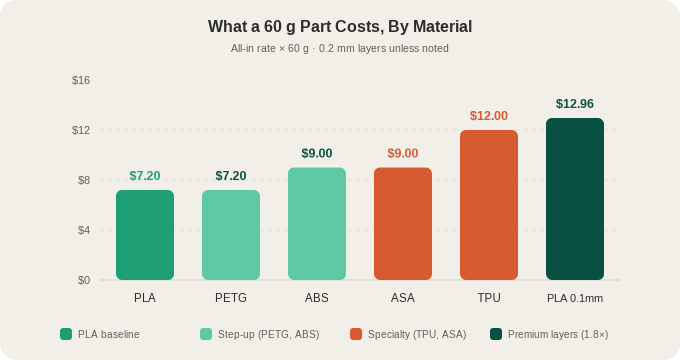
Across the four rigid filaments the spread is three cents a gram, which sounds like nothing and mostly is. TPU is the exception, at a little over twice PLA's rate. Here is a real 60 g part, a desk-sized bracket at 0.2 mm layers, priced across the whole menu, plus the same part in PLA at our premium 0.1 mm layer height, which multiplies the rate by 1.8.
| Material | Rate | 60 g part | vs PLA |
|---|---|---|---|
| PLA | $0.12/g | $7.20 | Baseline |
| PETG | $0.12/g | $7.20 | Same |
| ABS | $0.15/g | $9.00 | +$1.80 |
| ASA | $0.15/g | $9.00 | +$1.80 |
| TPU 95A | $0.25/g | $15.00 | +$7.80 |
| PLA at 0.1 mm | $0.12/g × 1.8 | $12.96 | +$5.76 |
Read that last row twice. Choosing the toughest, most weather-proof filament on the menu costs $1.80 on this part. Choosing premium 0.1 mm layers costs $5.76. Among the rigid plastics, material almost never deserves to be the thing you economise on; geometry and layer height are where the money is. Flexibility is the exception: TPU 95A adds $7.80 here, more than premium layers cost, so use it where the part has to bend and nowhere else. Full rate sheet, bulk tiers, and shipping rules are on /pricing.
Where People Choose Wrong
- Reaching for ABS out of habit. PETG covers most of what people want ABS for, prints more reliably, and costs less.
- Paying for ASA on an indoor part. If it never sees sun, the UV package is dead weight in your quote.
- Choosing a material to fix a strength problem. Nine times out of ten the fix is more wall perimeters or a smarter print orientation, not a tougher polymer.
- Picking TPU for something rigid that just needs one flexible feature. Print the body in PETG and the seal in TPU as two parts.
- Assuming PLA is weak. It is the stiffest of the five and takes the most load before it deflects. Its problem is heat and sun, not strength.
How the Choice Plays Out on Our Farm
You pick the material on the upload page; everything after that is ours. Our fleet is Bambu Lab H2S and P2S machines with a 340 × 320 × 340 mm build volume and a 4-tray AMS on each, so a material change is a tray change rather than a teardown. That is why the price difference between PLA and ASA is cents rather than a surcharge. We slice your actual file in OrcaSlicer to quote it, validate the resulting G-code for safety before it reaches a printer, and an operator watches the job on a live camera while it runs.
Upload STL, 3MF, or a plate you sliced yourself as .gcode.3mf at /print. OBJ is not accepted, so export STL or 3MF instead. Normal print ships in 4 to 5 business days, or 1 to 2 with Priority print (10% of the items, at least $10).
FAQ
What is the best filament for beginners?
PLA, without much of a contest. It is as cheap as anything on the menu at $0.12/g all-in, holds the finest detail, warps the least, and has no meaningful failure mode indoors. Start there and only move up when one of the three questions above comes back yes.
Is PETG always better than PLA?
No. PETG buys heat and water resistance, but it is slightly less stiff, holds sharp detail a little less crisply, and strings more on models with lots of gaps. For a display piece, a figurine, or a desk organiser that never sees the sun, PLA prints better at the same price per gram.
Can I order different materials in one order?
Yes. Each part in your cart carries its own material and is priced at its own rate, so a PETG enclosure and a TPU gasket ship together in one box. Bulk discounts count copies of the same part (5% off at 5 or more, 10% off at 10 or more), and one $7 flat shipping charge covers the whole US order, free over $49.50.
What if I genuinely do not know how hot or how sunny it gets?
Describe the environment in the notes at checkout rather than guessing at a material. Telling us the part mounts on a bike frame, or sits inside a sealed 3D printer enclosure, gives us more to work with than a filament name, and we would rather spend a cent a gram more than reprint the job.
Price it now
What would yours cost?
A real example, priced by the same engine our checkout uses: a 50 g TPU part comes to $13.00 printed, plus $7.00 US shipping and a $5.00 small cart fee, which comes off at $25.00 or more in items. Change the weight, material or quantity below and the price follows.
- 50 g × $0.25/g, per part
- $12.50
- Rounded up to the whole dollar
- +$0.50
- Small cart fee
- +$5.00
- Shipping
- $7.00
Add $12.00 more in items and this fee comes off.
The same through the cart, where postage is free on orders of $49.50 or more.
Upload a file for the exact priceAn estimate from the weight you entered. The real quote weighs your file.
Two ways to your real price
Have a file?
Upload it. See the exact price.
Drop in your STL or 3MF. We slice it the way our printers will and price the grams it really uses. No account needed to see it.
Only an idea?
Describe it. We’ll email you a price.
No file, no problem. A few words on what it is and how big is plenty to start.
Or write to contact@x3dstudios.com