Case Study: 100 Custom Parts Without Touching a Printer
One hundred identical custom parts can be designed, quoted, printed, and delivered without owning a printer, touching a slicer, or scheduling a single plate change. You upload one file, pick a material, and the farm does the rest. This walkthrough follows a 100-unit run of a 14 g PLA mounting bracket from file to doorstep: $151.20 all in, five build plates, three printers, and 19 hours 30 minutes of wall-clock machine time. Every number below comes from our published rates and a real OrcaSlicer slice of a part this size. It is a worked example, not a named customer.
The Brief: 100 Custom Parts, One File
The part is a sensor mounting bracket, the kind of thing a small hardware team needs a hundred of and no supplier sells. It bolts a small PCB to 20 mm extruded aluminium: two through-holes for M4 bolts, a flat back face, a raised lip so the board sits proud of the rail. Nothing exotic. It just has to exist a hundred times and it has to fit.
| Spec | Value |
|---|---|
| Part | Sensor mounting bracket |
| Bounding box | 62 x 38 x 22 mm |
| Quantity | 100 |
| Material | PLA, single colour |
| Layer height | 0.2 mm standard |
| Infill | 20% gyroid, 3 walls |
| Sliced weight | 13.4 g, billed as 14 g |
That last row matters more than it looks. Billable weight rounds up to the whole gram, so 13.4 g bills as 14 g. Across 100 units that rounding is 60 g of phantom plastic, or $7.20. It is worth knowing about, and it is worth not worrying about: shaving the part to 12.9 g to dodge a gram is an afternoon of CAD to save the price of a coffee.
Step 1: A File the Farm Can Actually Slice
The bracket started life in CAD and left as a single STL. That is the boring, correct answer. We accept STL, GLB, 3MF, and G-code (.gcode or .gcode.3mf). STL and GLB uploads can be up to 100 MB; already-sliced files up to 40 MB. We do not accept OBJ, which trips up more people than any other format question we get, because plenty of CAD and sculpting tools offer it as a default export.
For a repeat run like this one, 3MF is the better upload. It records real-world units, so there is no ambiguity about whether the model is 62 mm or 62 inches, and it survives round-trips through Bambu Studio without losing your intent. If you are unsure which format your tool should be producing, What File Do I Need to 3D Print Something? sorts it out in a few minutes.
Step 2: The Quote Came From a Real Slice
Most online quoting tools estimate weight from bounding-box volume and a fudge factor. Ours slices the model in OrcaSlicer wherever possible and reads the grams back off the result, which is why the quote said 13.4 g rather than a round guess. At PLA's all-in rate of $0.12 per gram, covering both filament and normal machine time, the bracket prices at $1.68 each before any discount, comfortably above the $1.00 per-part minimum.
Bulk pricing then does the work. Orders of 5 or more units take 5% off; 10 or more take 10%. There is no separate 100-unit tier, so the per-part price at 100 is the same as at 10. What actually changes between those two orders is shipping: $7 flat within the US, free once the order clears $50.
| Quantity | Parts subtotal | Bulk discount | Shipping | Order total | Per part delivered |
|---|---|---|---|---|---|
| 1 | $1.68 | - | $7.00 | $8.68 | $8.68 |
| 5 | $8.40 | -5% | $7.00 | $14.98 | $3.00 |
| 10 | $16.80 | -10% | $7.00 | $22.12 | $2.21 |
| 25 | $42.00 | -10% | $7.00 | $44.80 | $1.79 |
| 100 | $168.00 | -10% | Free (over $50) | $151.20 | $1.51 |
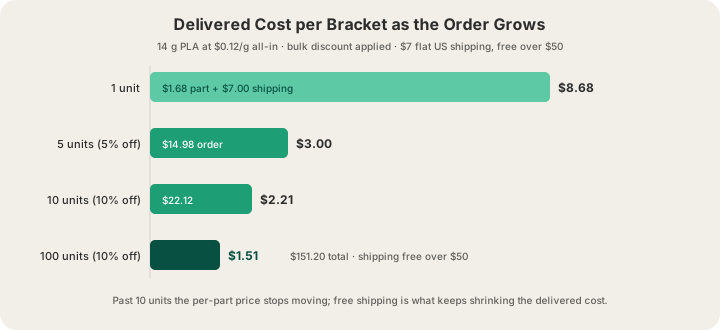
The curve flattens hard. Between 1 and 10 units the delivered price per part drops 75%, almost all of it from spreading $7 of shipping across more parts. Between 10 and 100 it drops another 32%, and that last stretch is purely the free-shipping threshold. If you are pricing a hardware product and wondering where the per-unit cost lands, How Much Does Custom 3D Printing Cost in 2026? Full Pricing Breakdown has the general version of this maths, and /pricing has the live rates.
What the Other Choices Would Have Cost
Two settings could have changed the bill: layer height and material. Premium 0.1 mm layers price at 1.75x the material rate. Neither was worth it here, because this bracket lives inside an enclosure and nobody will ever look at its layer lines.
| Option | Rate | Per part | 100 units after 10% off |
|---|---|---|---|
| PLA, 0.2 mm (chosen) | $0.12/g | $1.68 | $151.20 |
| PLA, 0.1 mm premium | $0.21/g | $2.94 | $264.60 |
| PETG, 0.2 mm | $0.12/g | $1.68 | $151.20 |
| ABS, 0.2 mm | $0.12/g | $1.68 | $151.20 |
| ASA, 0.2 mm | $0.14/g | $1.96 | $176.40 |
The comparison holds the 14 g billable weight constant to isolate the rate; real weight shifts slightly with each material's density. The honest read is that material choice moves this order by tens of dollars while layer height nearly doubles it. Choose the material for the environment the part lives in, and reach for premium layers only when a surface is going to be seen or measured.
Step 3: Five Plates on a 340 mm Bed
The Bambu Lab H2S gives us 340 x 320 x 340 mm to work with. A 62 x 38 mm bracket footprint plus 8 mm of skirt clearance means each part claims roughly 70 x 46 mm of bed, which packs into a 4 x 6 grid: 24 brackets per plate. One hundred parts is therefore four full plates and one nearly empty one holding the last four.
That fifth plate is the part of batch printing nobody mentions. A run of 96 would have been four clean plates and finished in the same wall-clock time as a run of 100. If you have flexibility on quantity, rounding down to a plate boundary is free speed. If you do not, the farm absorbs it and you never notice.
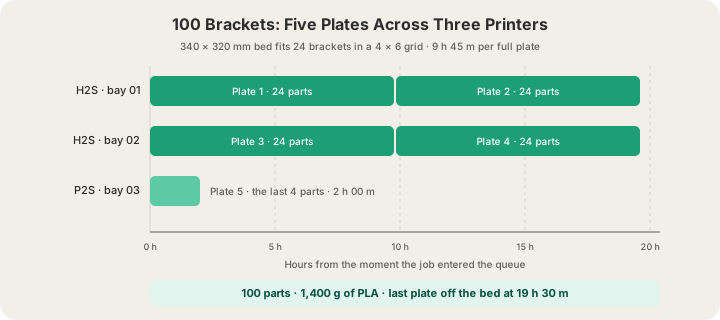
Each full plate slices to about 9 hours 45 minutes. The scheduler put two plates on each of two H2S machines and dropped the four-part remainder onto a P2S, where it finished in roughly two hours and freed the machine for something else. Total machine time across the fleet was about 41 hours; total wall-clock time from queue to last plate was 19 hours 30 minutes, because three printers were doing it at once. That difference is the entire argument for a farm, spelled out in One Printer vs a Farm: What Scaling Actually Takes.
Step 4: What Happened While Nobody Watched
Before any of those plates started, the generated G-code went through safety validation: bed and nozzle temperatures checked against the material, motion bounds checked against the build volume, no commands that would drive a toolhead into a limit. We run that on every file, including ones we sliced ourselves, because a farm that skips it eventually finds out why in the most expensive way available.
The run was single-colour, which kept it simple. Each machine's AMS has four trays, so a second or third colour would have been available had the client sliced the plate for it — a model we slice runs in one filament — and every change on such a plate costs about 1.3 minutes and roughly 84 mm3 of purged plastic. On a 24-part plate with a colour swap every layer, that purge becomes the dominant cost. For a bracket that lives inside a box, one colour was the obvious call.
- G-code validated before the first plate was assigned
- Live camera streams on every bay, so a failed first layer is caught in minutes rather than at hour nine
- Auto-eject clears a finished plate so the next job starts without waiting for a human
- Order stages visible the whole way: placed, printed, packed, shipped, delivered
Step 5: Packed, Shipped, Done
One hundred brackets is about 1.4 kg of plastic and one medium box. Shipping was free because the order cleared $50 by a wide margin. Most orders leave the Austin farm within 24 to 48 hours of being placed, and this one was not an exception: printing finished overnight, packing happened the next morning, and the tracking number posted the same day. Local customers can skip freight entirely and collect in Austin.
The Version Where You Do It Yourself
The comparison worth making is not farm versus factory, it is farm versus your own desk. Assume you already own a capable printer, so hardware cost is zero. You still owe the run about 41 hours of machine time, and one printer can only serve it serially.
| Your printer | X3D farm | |
|---|---|---|
| Machine time needed | ~41 h | ~41 h across 3 machines |
| Wall-clock to finish | About 2 days, continuous | 19 h 30 m |
| Plate changes you perform | 5, at least one overnight | 0 |
| Filament you buy and store | 1.4 kg, plus spare | None |
| Failed plate re-runs | Yours to notice and redo | Re-queued for you |
| Packing and postage | Your afternoon | Included |
| Cash outlay | Filament + electricity + your time | $151.20 |
There is no dishonest thumb on this scale. If you own a printer and enjoy running it, a hundred small brackets is a perfectly reasonable weekend. The farm's actual product is that the weekend belongs to you instead.
What We Would Change on the Next Hundred
- Model the M4 holes at 4.4 mm, not 4.0 mm. FDM holes print slightly undersize because of the inward pull of each perimeter, and a bracket you have to drill out a hundred times is a bracket that failed. /blog/3d-printing-tolerances-guide covers the compensation values.
- Orient for the load, not for the print time. Bolt holes take shear, and layer lines running the wrong way through a hole boss is the classic FDM failure, so say at checkout which face carries the load and we will orient for it.
- Order 96, not 100, when quantity is flexible. Four full plates beat four plates plus a rump.
- Add a note at checkout if a specific infill or wall count matters. Absent a note, we use geometry-based defaults tuned for strength per gram.
FAQ
How much does it cost to 3D print 100 parts?
It depends almost entirely on weight, not size or complexity. At our all-in PLA rate of $0.12 per gram, 100 parts weighing 14 g each come to $168.00, less the 10% bulk discount for orders of 10 or more, for $151.20. Shipping is free above $50, so that $151.20 is the delivered total. Swap in your own part weight and the same arithmetic works.
Do I need to upload 100 copies of my file?
No. Upload the part once and set the quantity in the cart. The farm arranges copies onto plates itself, which is how you get 24 brackets on a 340 x 320 mm bed rather than whatever spacing you guessed at in your own slicer.
How long does a 100-part run take?
This one took 19 hours 30 minutes of wall-clock printing across three machines, and shipped inside the usual 24 to 48 hour window. Runs get slower when parts are tall rather than numerous, because height is serial and quantity is parallel. A 250 mm tall part cannot be split across printers; a hundred short ones can.
What if one of the parts comes out bad?
It gets re-queued before it ever reaches the box. Live cameras catch first-layer failures within minutes, and finished parts are inspected before packing. On a 100-unit order a single reprint is one slot on an otherwise idle machine, which is a very different problem than it is when you own the only printer in the room.
Ready to get started?
Upload a 3D model for instant pricing, or generate one with AI.