How Much Does 3D Printing Cost? Custom Prints in 2026
How much does 3D printing cost? Custom 3D printing typically costs $0.12 to $0.14 per gram all-in for rigid FDM plastics and $0.25 for flexible TPU — material and machine time in one rate — which means most desk-sized objects land between $6 and $50 including shipping. The final price depends on four things: material, size, infill density, and finish quality. Here's exactly how the math works, so you can estimate your cost before you upload a file, or let /3d-print-cost-calculator do the arithmetic from a weight.
How much 3D printing costs per material (real numbers)
These are our live rates at X3D Studios Print & Ship — all-in per-gram pricing (filament and machine time together), with just a $1 minimum:
| Material | Price (all-in) | Best for |
|---|---|---|
| PLA | $0.12/g | Decor, prototypes, low-stress parts |
| PETG | $0.12/g | Functional parts, outdoor use, water resistance |
| ABS | $0.12/g | Heat-resistant, impact-tough parts |
| ASA | $0.14/g | UV-stable outdoor parts |
| Flexible TPU | $0.25/g | Gaskets, phone cases, flexible hinges |
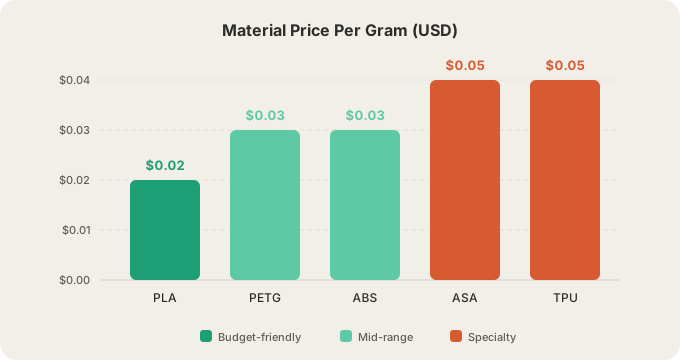
A typical 100g object — roughly the size of a desk clock — costs $12–$14 all-in in the rigid plastics, or $25 in flexible TPU, machine time included. Industrial services quoting the same part often start at $30–$50 because they add setup fees, manual labor, and minimum order charges on top.
The four factors that drive your quote
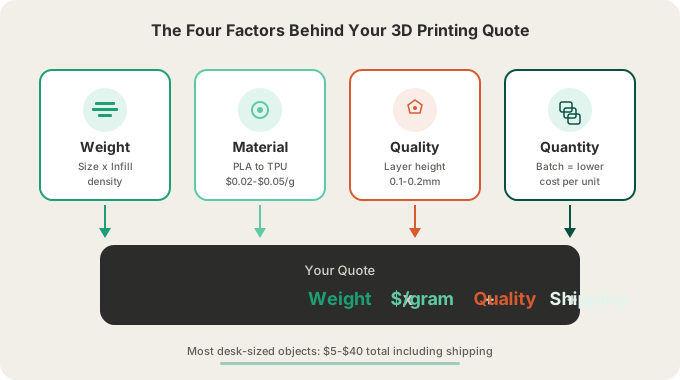
1. Weight (size × infill)
Printed parts aren't solid. Most objects use 20% infill — a honeycomb interior that keeps parts strong at a fraction of the material. Doubling a model's dimensions roughly 8× its volume, so size is the biggest cost lever. Scaling down 20% often halves the price.
2. Material choice
PLA and PETG are the cheapest at $0.12/g, and PLA prints beautifully — if your part lives indoors and won't see heat above ~50°C, it is all you need. Choose PETG/ABS for functional parts and ASA or TPU only when you need UV stability or flexibility.
3. Quality (layer height)
Standard 0.2mm layers are right for most parts. Premium 0.1mm layers roughly double machine time, so they price at 1.75× the standard rate — worth it for display pieces with fine detail, unnecessary for functional prototypes.
4. Quantity
Several copies of one part take a volume break off the whole line: 5% from five copies and 10% from ten, applied when the quantity is priced as one job, with Print & Ship on /print or through the print API. There is no mould and no setup fee, so the price per part stays flat from the first copy to the last. /bulk-3d-printing covers batch work, with a live lead time for large runs.
Example price estimates
| Object | Approx. weight | Material | Estimated cost |
|---|---|---|---|
| Phone stand | 40 g | PLA | ~$4.80 + shipping |
| Desk clock body | 100 g | PLA | ~$12 + shipping |
| Replacement appliance knob | 15 g | PETG | ~$1.80 + shipping |
| Cosplay helmet piece | 400 g | PLA | ~$48 + shipping |
| Flexible phone case | 35 g | TPU | ~$8.75 + shipping |
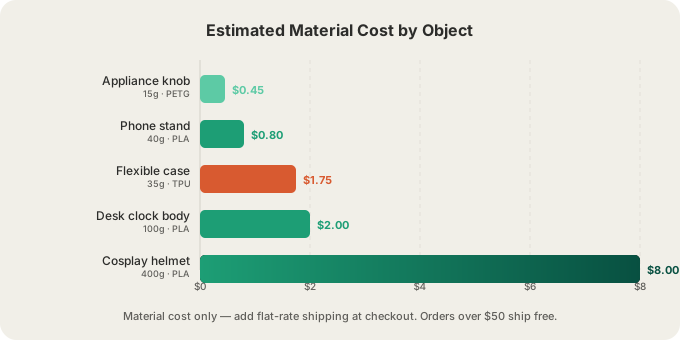
Shipping from Austin is added at checkout: $7 standard or $15 express in the US, and standard postage is free on cart orders of $49.50 or more. To price your own part from its weight, with the quantity, colours and shipping you want, use /3d-print-cost-calculator.
Don't have a 3D model? That's no longer a cost barrier
Historically the most expensive part of custom 3D printing was the design work — CAD designers charge $30–$100+/hour. AI generation has collapsed that cost: describe what you want in a sentence in our AI Design Studio, and a Fast Draft model comes back in about 20 to 30 seconds. Every model is automatically validated for printability (watertight mesh, minimum wall thickness, overhang checks), so you're not paying to print a file that will fail.
How to get the cheapest possible print
- Use PLA unless the part has functional requirements.
- Scale down — even 10% smaller saves real money on larger parts.
- Keep 20% infill unless the part bears load.
- Standard quality for prototypes; save Premium for the final version.
- Combine parts into one order to hit free shipping.
FAQ
Is custom 3D printing cheaper than buying a product?
For mass-produced items, no. For discontinued parts, custom designs, and personalized objects, it's dramatically cheaper than any alternative — a $3 print can replace a $40 replacement part order.
How much does 3D printing cost per hour?
Most online services don't bill a print by the hour — they price by material weight and machine time bundled into a per-gram or per-part quote. That's why uploading your file for an instant quote beats estimating.
Why do quotes vary so much between services?
Industrial services (SLS, metal) carry higher machine and labor costs. FDM farms like ours price near material cost because the machines run largely unattended: little per-part labor, and the energy cost of a print is a few cents. /docs/pricing breaks down every line of a quote.
How fast will I get my print?
Normal print ships in 4–5 business days, or 1–2 with Priority print ($5 at checkout), then transit from Austin: 4–6 business days standard or 2–3 express.
Ready to see your number? Upload your model for an instant quote — or generate one with AI if you don't have a file yet.
Ready to get started?
Upload a 3D model for instant pricing, or generate one with AI.