Matte PLA vs Silk vs Standard PLA: Surface Finish Compared
Matte PLA, silk PLA and standard PLA are the same base plastic carrying different additives, so they print on the same machines at the same speed and cost the same $0.12 per gram all-in. The only thing that changes is how the surface handles light. Standard PLA is semi-gloss and reads honestly as a printed part. Matte PLA scatters light and is the cheapest way there is to hide layer lines. Silk PLA throws a bright, continuous sheen that flatters curves and exposes every flaw on a flat wall. Choose by what the part has to do in a photograph or in a hand, because the price is identical either way.
Matte PLA vs Standard and Silk, Side by Side
| Finish | Sheen | Layer lines | Layer strength | Best for |
|---|---|---|---|---|
| Standard PLA | Semi-gloss | Visible as bright stripes | Baseline | Functional parts, prototypes, anything you plan to paint |
| Matte PLA | None, slightly chalky | Best hidden of the three | Close to baseline | Product photos, props, dark colours, big flat faces |
| Silk PLA | High, near-metallic | Amplified by the gloss | Weakest of the three | Vases, ornaments, curved showpieces |
Notice what is missing from that table: a price column and a speed column. There is no finish surcharge, no slower profile, and no extra machine time. Every row prints at 0.2 mm layers on the same Bambu H2S and P2S machines and bills at the same rate, which makes finish the one quality decision in 3D printing that is genuinely free.
Finish Is an Additive, Not a Setting
Standard PLA is base resin plus pigment, and nothing else has to happen for it to look the way it looks. Matte PLA adds a very fine mineral filler that roughens the surface at a scale far below what your eye resolves; the roughness scatters incoming light in every direction instead of bouncing it back as a highlight. Silk PLA goes the other way, blending in a co-polymer that makes the extruded bead flow out glassy and smooth, so the surface reflects like a curved mirror rather than a diffuser. /docs/materials compares all five materials, their rates and what each is for.
That matters because a printed wall is not flat. It is a stack of rounded beads, each one a small horizontal cylinder with its own curved top. On a glossy surface every one of those cylinders catches the room light and throws back a narrow bright line, and your eye stitches the lines into stripes. The geometry is identical on a matte part. The highlight is not there, so the stripes never resolve.
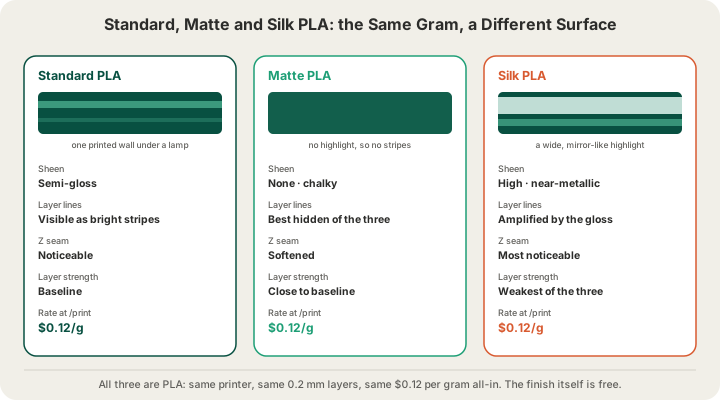
This is also why finish and layer height are two different levers that get confused for one. Layer height changes how big the beads are, and 3D Printing Layer Height Explained: 0.08 vs 0.2 vs 0.28 works through what 0.08, 0.2 and 0.28 mm actually buy you. Finish changes whether you can see the beads at all. The same logic applies to the vertical scar where each layer starts and stops: on matte PLA a well-placed seam nearly disappears, while on silk it catches light along its whole length. Z-Seam in 3D Printing: How to Hide It on Visible Prints covers where to put that seam before you pick the spool.
What Changes Besides the Look
Silk PLA is the weakest of the three, and it is not close. The additive that makes the melt flow smoothly also makes each new bead weld less firmly to the one below it, so silk parts split along a layer line under loads that standard PLA shrugs off. A silk vase is a lovely object. A silk bracket is a countdown. If a part carries weight, gets threaded, snaps into something, or lives in a car in an Austin July, look at standard PLA first and at PETG second.
Matte PLA is close enough to standard in strength that most people cannot tell them apart by breaking them, but the mineral filler is mildly abrasive and slowly wears a brass nozzle. On a farm that is a maintenance line item rather than something a customer ever sees, and it is one of the reasons nozzle condition is tracked per machine rather than per month. Matte has one other quirk worth knowing: it hides defects as well as it hides layer lines. Mild under-extrusion that would be obvious as a glossy gap is invisible on a matte surface until you run a fingernail across it.
Standard PLA is the reference for a reason. It bridges predictably, it takes primer and paint without preparation, and it is the finish where a bad print looks bad, which is exactly what you want during prototyping. If you are printing a part to check whether it fits, print it standard and save the pretty spool for the version that ships.
What Each Finish Costs
Nothing extra, is the short answer. All three are PLA, and PLA prints at $0.12 per gram all-in on our farm, filament and normal machine time together. What does cost money is buying smoothness with layer height instead of with pigment: premium 0.1 mm layers price at 1.75 times the standard rate. Here is the same 62 g desk piece four ways.
| Part | Layers | Effective rate | Price |
|---|---|---|---|
| Matte PLA | 0.2 mm standard | $0.12/g | $7.44 |
| Standard PLA | 0.2 mm standard | $0.12/g | $7.44 |
| Silk PLA | 0.2 mm standard | $0.12/g | $7.44 |
| Standard PLA | 0.1 mm premium | $0.21/g | $13.02 |
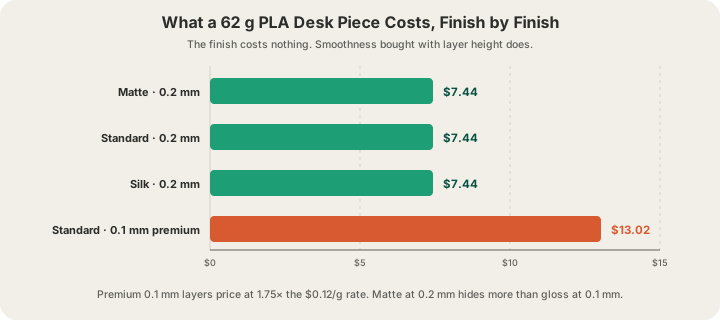
The practical conclusion is worth stating plainly: for a part that only needs to look smooth in a photograph, matte at 0.2 mm beats gloss at 0.1 mm and saves $5.58 on this example. Spend the premium rate on parts where the geometry itself is fine and curved, not on parts where you are really just fighting a highlight. Live rates for every material and quality are on /pricing.
Two smaller rules apply at both ends of the scale. Every part has a $1.00 minimum, so a 6 g silk keychain computes to $0.72 and bills at $1.00 rather than the fraction. And US shipping is $7 standard, free over $49.50, or $15 express, which is why ordering a matte set and a silk set together generally costs less than ordering them a week apart.
Picking a Finish by What the Part Is
- Anything you are going to photograph: matte. Product shots live or die on whether a light source turns your part into a barcode, and matte is the only finish that never does.
- Dark colours, especially black: matte. Glossy black is the hardest surface in FDM to photograph, because the highlights are the only thing the camera sees.
- Vases, shades, ornaments, spiral-mode shells: silk. Continuous curves are where the sheen becomes an effect instead of a distraction.
- Brackets, jigs, hinges, mounts, anything under load: standard, and check whether it should be PETG instead.
- Parts you will prime, sand and paint: standard or matte. The paint decides the finish, so buy the strongest base.
- Large flat vertical faces: matte. Flat and glossy is the worst combination there is for hiding a layer line, and silk makes it worse still.
You can also mix them in one part. A matte body with silk accents on a 4-tray AMS looks far more deliberate than either finish alone, and the finishes have no trouble sharing a hotend. What that costs is what any colour print costs: the two-colour rate, $0.15 per gram in PLA instead of $0.12, plus 84 mm³ of purged filament per change and the machine time to do it, and how many changes there are is set by how the colours stack up the Z axis. If you want the multi-tone look without paying for changes at all, Silk Filament and Gradient Filament: One Spool, Many Colors covers the single-spool route.
How to Order a Specific Finish
Upload your STL or 3MF (a sliced plate as .gcode.3mf) at /print and pick the colour swatch closest to what you want, or type an exact hex into the custom colour field. Then add a note at checkout naming the finish: matte, silk, or standard. The swatches themselves show the standard set, so the note is what tells the farm which spool to load. Quotes come from a real OrcaSlicer slice of your model wherever possible, not a volume guess, so the number you see is the number the machine will actually consume.
Everything prints in Austin, Texas: normal print ships in 4–5 business days, or 1–2 with Priority print (10% of the items, at least $10). Build volume is 340 × 320 × 340 mm per plate, which is enough for most single-piece decor at the sizes where a finish choice matters.
FAQ
What is matte PLA, and does it really hide layer lines?
Matte PLA is PLA with a very fine mineral filler that roughens the surface, and it genuinely hides layer lines. The mechanism is optical rather than dimensional. The layers are exactly as tall as they would be in standard PLA, but each bead no longer produces a specular highlight, so the row of bright lines your eye was using to detect them is gone. Under a raking light, matte at 0.2 mm typically reads smoother than gloss at 0.1 mm, which is why it is the cheaper path to a smooth-looking part.
Is matte PLA weaker than regular PLA? What about silk?
Matte, barely: it is close enough to standard PLA that most people cannot tell them apart by breaking them. Silk, yes, mainly in layer adhesion. The additive that produces the sheen reduces how strongly each layer welds to the one beneath it, so silk parts tend to fail by splitting along a layer rather than by breaking through the plastic. It is a fine material for anything decorative and a poor choice for anything that gets clamped, threaded or dropped. Orientation helps a little, since a part loaded across its layers survives longer than one loaded along them.
Does choosing silk or matte change what my print costs?
No. All three are PLA and all three bill at $0.12 per gram all-in, with a $1.00 minimum per part and $7 flat US shipping. The only surface-related setting that changes the price is layer height: premium 0.1 mm layers price at 1.75 times the standard rate, so the 62 g example above goes from $7.44 to $13.02 while the finish column stays free.
Can I mix matte and silk in one print?
Yes, on a plate you paint yourself. The 4-tray AMS on each machine does not care whether the trays hold different colours or different finishes, so a matte base with silk lettering is an ordinary multi-colour job — painted in Bambu Studio or OrcaSlicer and uploaded as the project, which we slice in its colours, or as a .gcode.3mf you sliced, since a plain STL runs one filament. It prices like any two-colour plate too: $0.15 per gram in PLA ($0.12 plus $0.03 for the second filament) on the weight the slice reports, purge included, plus machine time for the hours that weight cannot explain.
Ready to get started?
Upload a 3D model for instant pricing, or generate one with AI.