3D Printing API vs Traditional Fulfillment Services
A 3D printing API and a traditional fulfillment service solve the same problem — getting a physical part into someone's hands — but they run the steps in opposite order. Traditional fulfillment asks you to commit first: agree a quote, manufacture a batch, warehouse it, then draw units out of stock as orders arrive. An API-first print farm inverts that. Your software POSTs a file and a shipping address, the price comes back in the same response, and the part is manufactured because an order exists — not before. The practical difference is where your money sits while you wait: in inventory, or nowhere at all.
3D Printing API vs Fulfillment: The Short Version
"Traditional fulfillment" is really two different businesses wearing the same coat. One is the service bureau, where you email a drawing and a human sends back a quote. The other is the stock-and-ship warehouse, where you manufacture inventory up front and pay someone to hold and pick it. Both are mature, both work, and both assume a human decision sits somewhere in the loop. An API removes the loop entirely for the class of parts a print farm can make.
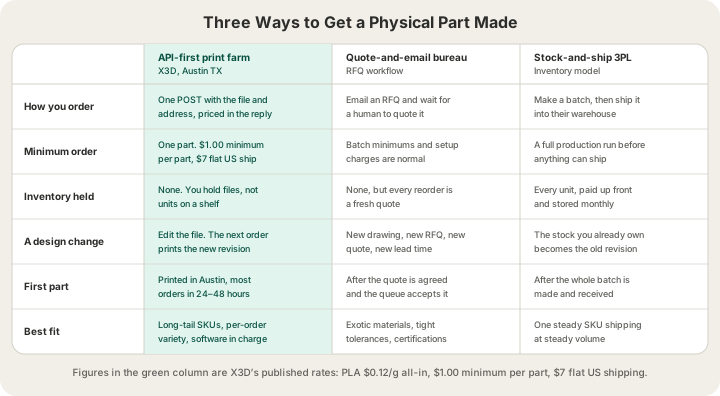
| 3D printing API | Bureau RFQ | Stock-and-ship fulfillment | |
|---|---|---|---|
| Order path | One authenticated POST | Email, drawing, human quote | Make a batch, then pick from stock |
| When you learn the price | In the same response | When the quote comes back | When you commit to the run |
| Minimum | One part, $1.00 minimum | Batch minimums are common | A full production run |
| Capital at risk | Nothing before the order | Nothing, but time is spent | Every unit that never sells |
| A design change costs | Editing the file | A fresh RFQ cycle | The stock you already own |
| First part out the door | Most orders in 24–48 hours | Quote, then queue, then print | Same day — once stock exists |
| Strongest at | Variety, low volume, software-driven demand | Exotic processes and certifications | One steady SKU at steady volume |
What Traditional Fulfillment Actually Covers
The quote-and-email bureau
A service bureau aggregates manufacturing processes — SLS, MJF, SLA, CNC, metal — and prices them by human review because the processes genuinely differ. That review is not bureaucracy for its own sake: a titanium bracket and a nylon housing need someone to look at the drawing. The cost is latency. Every revision restarts the conversation, and a part you order once a month is a relationship you maintain forever. If your part is a plastic enclosure that any FDM machine can make, you are paying for judgment you do not need. That trade-off is broken down further in Bulk 3D Printing Services Compared: Print Farms vs Industrial Bureaus (2026).
The stock-and-ship warehouse
The 3PL model is the one most e-commerce founders picture: you have units made, you ship them to a warehouse, and the warehouse picks, packs and posts them as orders come in. It is extremely good at what it is good at. Once the pallet is on the shelf, an order placed at 10am can leave the same afternoon, and the marginal cost of the tenth thousand unit is tiny. What it cannot do is start. Before a single order exists you have paid for a production run, a freight leg and a storage account — and every one of those units is a bet that the design will not change.
What the API Actually Replaces
Strip a fulfillment relationship down and most of it is negotiation and bookkeeping. Here is what disappears when the farm is addressable over HTTP:
- The quote request. Price is a function of weight and material, so it can be computed and returned synchronously.
- The purchase order. The card on file is charged when the order is created, and the amount charged is in the response body.
- The inventory forecast. There is nothing to forecast, because nothing is made until it is bought.
- The revision email. A new file is a new order; the old file is simply never printed again.
- The status phone call. Order state is a GET, and a webhook can push it to you instead.
In practice that collapses into a single multipart request. The file, the address and a Bearer key go up; an order code, the exact amount charged and a status URL come back. The full field list lives in /api-docs, and a longer walkthrough of the first integration is in Add 3D Printing to Your App With One POST Request.
curl -X POST https://x3dstudios.com/api/print/orders \
  -H "Authorization: Bearer x3d_live_..." \
  -F "[email protected]" \
  -F "material=pla" -F "quality=standard" -F "quantity=1" \
  -F "recipientName=Dana Reyes" \
  -F "street1=1100 Congress Ave" \
  -F "city=Austin" -F "state=TX" -F "zip=78701" -F "country=US"

# 201 Created
{
  "code": "X3D-K7M2QP",
  "status": "RECEIVED",
  "paid": true,
  "estimatedCost": 10.24,
  "breakdown": { "print": 3.24, "shipping": 7, "grams": 27, "printHours": 1.32 },
  "statusUrl": "https://x3dstudios.com/print/order/X3D-K7M2QP"
}
That 27-gram bracket costs $3.24 to print at our $0.12 per gram all-in PLA rate, plus $7 flat US shipping. No setup fee, no batch minimum, no account manager. The same request with quantity 25 is the same request.
The Cost of Not Holding Inventory
The usual objection to on-demand manufacturing is that per-unit cost never falls. That is half true. Tooling amortisation does not exist here, so you never get the injection-molding cliff where unit cost collapses at volume. But order economics still improve, because a bigger order spreads one shipment and one setup across more parts.
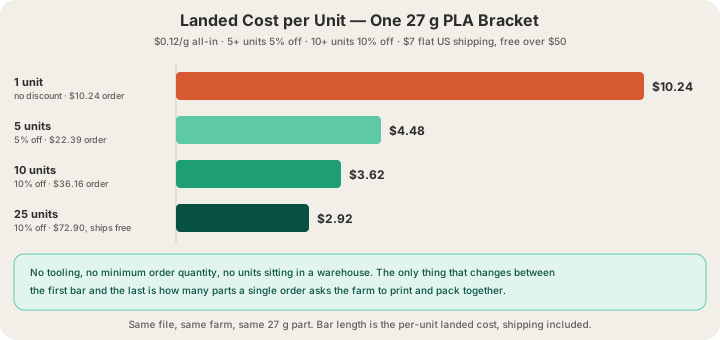
One bracket lands at $10.24 because a $7 shipping label sits on top of $3.24 of plastic. Five brackets take the 5% bulk discount and land at $4.48 each. Twenty-five take 10% off and clear the $50 threshold where US shipping becomes free, landing at $2.92 each — a 71% drop from the single unit, with zero units held and zero tooling paid for. A stock-and-ship model can beat $2.92 at high enough volume, but only after it has paid for the run.
Lead Time: Where the Days Actually Go
A fulfillment warehouse's lead time is short and its setup time is long. An API farm's is the reverse: setup is one API key, and lead time is however long the part takes to print, inspect and post. Most orders leave our Austin farm within 24 to 48 hours, and the stages customers see are deliberately boring — placed, printed, packed, shipped, delivered.
Inside those stages, the work is automated rather than queued behind a person. An uploaded mesh is checked against the 340 × 320 × 340 mm build volume of our Bambu Lab H2S machines and sliced in OrcaSlicer for a real measured weight. An already-sliced G-code file skips straight to safety validation, which is described in Why We Validate Every G-code File Before It Prints. Jobs land on an H2S or P2S with a four-tray AMS attached, and live cameras mean an operator can see every plate without walking the floor. If you are in Austin, pickup removes the shipping leg entirely.
Where Traditional Fulfillment Still Wins
There is no version of this comparison where the API wins everything. Choose the older models when:
- You ship one SKU at high, predictable volume — at that point tooling and warehousing genuinely are cheaper per unit.
- You need a process a print farm does not run: metal, SLS nylon, machined tolerances, or a certified aerospace or medical process.
- The part will not fit. A 340 × 320 × 340 mm plate is generous for FDM, but it is a ceiling, and splitting a model has its own costs.
- Same-hour dispatch is the product. Nothing beats a picker walking to a shelf that already has your item on it.
- You need surface finish FDM cannot give without post-processing, and volume is high enough that hand-finishing every part is not viable.
The Hybrid Most People Actually Want
The interesting answer is usually not one or the other. Products that sell steadily belong in stock, where picking is instant and per-unit cost is lowest. Everything else — the long tail, the personalised variants, the first hundred units of something unproven, the replacement part for a discontinued revision — belongs behind an API, because those are exactly the items a warehouse handles worst. Deciding per-SKU rather than per-company is how a small team gets warehouse economics on the SKUs that deserve them and zero inventory risk on everything else.
Routing that decision in software is the part that used to be impossible. Now it is an if-statement: in stock, ship from stock; otherwise, POST the file. The broader case for treating manufacturing as an addressable service is in The 3D Printing API: Manufacturing as Code Is Coming, right down to the part where an order code becomes just another event stream your app already knows how to consume. If you want to see the pricing before you write any code, upload a file at /print and the quote comes from a real slice of your model.
FAQ
Is a 3D printing API cheaper than a fulfillment service?
Per unit at high volume, usually not. On landed cost across a real product line, often yes, because the API never charges you for units that do not sell, storage months, or a design revision that strands existing stock. Our rate is $0.12 per gram all-in for PLA with a $1.00 minimum per part and $7 flat US shipping — so a 27 g bracket is $3.24 to print whether you order one or one hundred, before bulk discounts.
Can I use a print API without holding any inventory at all?
Yes — that is the normal way to use one. Your product catalogue is a set of model files. When an order comes in, your server POSTs the matching file and the customer's address, the card on file is charged, and the part is printed and shipped to them directly. Nothing physical exists in your business at any point.
How fast does an API order actually ship?
Most orders print within 24 to 48 hours of landing at the farm, then ship. The variable is print time, not paperwork: a 27 g bracket is a bit over an hour on the machine, while a large multi-colour plate can run overnight. The status endpoint returns the current stage, so your app can show a customer the same thing our dashboard shows an operator.
What happens if the file is wrong?
It fails at the request, not three days later in an email. Unsupported formats return a 415, models larger than the 340 × 320 × 340 mm plate are rejected with the build-volume message, and sliced G-code goes through a safety check before any printer is allowed to run it. A failure you can catch in a try/catch is worth a great deal more than a failure someone has to telephone you about.
Ready to get started?
Upload a 3D model for instant pricing, or generate one with AI.