FDM vs SLA vs SLS: Which 3D Printing Technology to Pick
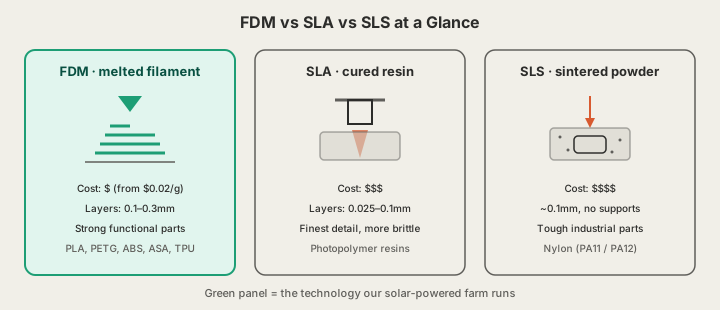
FDM melts plastic filament and draws parts layer by layer; it is the cheapest and most versatile technology. SLA cures liquid resin with light and wins on fine detail. SLS fuses nylon powder with a laser and produces the toughest parts with no support structures, at industrial prices. For roughly 9 out of 10 functional parts, FDM is the right call on cost, speed, and strength, which is exactly why our print farm runs it. Here is the full comparison so you can pick with confidence.
How Each Technology Works
FDM: fused deposition modeling
An FDM printer feeds a spool of thermoplastic filament through a heated nozzle and deposits it in layers, typically 0.1 to 0.3mm thick. It is the technology behind nearly every desktop and farm printer, including the Bambu Lab CoreXY machines on our floor, which print at up to 500mm/s. Material choice is its superpower: PLA, PETG, ABS, ASA, and TPU cover everything from decor to outdoor brackets to flexible gaskets, starting at $0.12 per gram all-in.
SLA: stereolithography
An SLA printer cures liquid photopolymer resin with UV light, one layer at a time, at layer heights down to 0.025mm. The result is a glass-smooth surface and detail no filament printer can match. The trade-offs are real: resin parts tend to be brittle, the liquid resin is messy and requires gloves, and every part needs washing in solvent plus a post-cure under UV before it is usable.
SLS: selective laser sintering
An SLS machine spreads a thin layer of nylon powder and a laser fuses the part's cross-section into it, layer after layer. Unfused powder supports the part, so there are no support structures at all, and you can nest dozens of parts in one build. Mechanical properties are the best of the three. The machines cost as much as a car, which is why SLS is priced for industrial budgets.
The Big Comparison
| FDM | SLA | SLS | |
|---|---|---|---|
| Typical part cost | $4–$24 | $15–$60 | $30–$150 |
| Layer height | 0.1–0.3mm | 0.025–0.1mm | ~0.1mm |
| Detail | Good | Excellent | Very good |
| Strength | Strong, slightly anisotropic | Brittle | Strongest, isotropic |
| Materials | PLA, PETG, ABS, ASA, TPU | Photopolymer resins | Nylon PA11/PA12 |
| Speed to shipped part | 24–48h on our farm | Days (wash + cure) | Days (cool + depowder) |
| Post-processing | Remove supports | Wash, cure, sand | Depowder, blast |
| Best for | Functional parts, prototypes | Miniatures, dental, jewelry | Complex production nylon |
Read the table with your actual part in mind, not the spec sheet. Detail only matters down to the smallest feature a human will see or touch; a phone stand does not benefit from 0.025mm layers. Strength only matters up to the real load; a desk organizer never tests its tensile limits. Cost and turnaround, on the other hand, apply to every single order, which is why the leftmost column wins so often in practice.
Which Should You Choose?
Choose FDM for functional parts and everyday objects
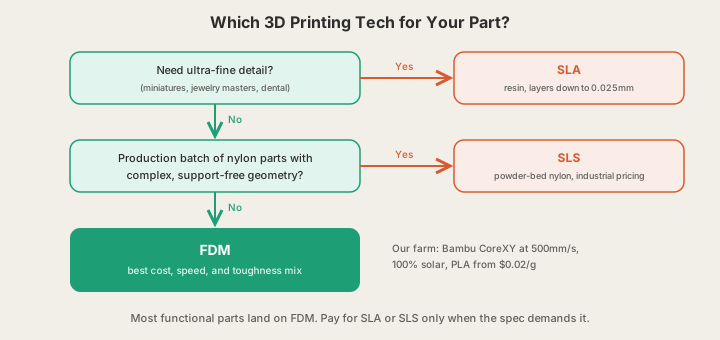
Brackets, enclosures, organizers, replacement parts, prototypes, decor, gifts, flexible parts in TPU: FDM covers all of it at the lowest cost per gram and the fastest turnaround. If the part needs to survive real use rather than sit in a display case, FDM with the right material is almost always the value pick.
Choose SLA when detail is the spec
Tabletop miniatures with 0.5mm facial features, jewelry casting masters, dental models, and display figurines justify resin. Just budget for the brittleness: a resin phone stand snaps where an FDM one flexes.
Choose SLS for complex production nylon
Interlocking assemblies, living hinges in nylon, and batches of end-use parts with geometry that would drown in supports are SLS territory. If your quantity is under 20 parts or your budget is under $30 each, you will rarely get a quote that beats FDM.
Why Our Farm Runs FDM
We picked FDM for the farm because it sits at the sweet spot of the three curves that matter for real orders: cost, speed, and toughness. High-speed CoreXY printers turn parts around in hours, five materials cover indoor, outdoor, heat, and flexible use cases, and pricing stays honest at $0.12 per gram all-in with a $1 minimum. FDM is also the most energy-efficient of the three technologies per part, which matters when the goal is net-zero manufacturing: our entire farm runs on 100% solar power, and every order ships in 24 to 48 hours with inspection photos.
The economics compound at volume. A batch of 50 enclosures that would quote at $40 each in SLS runs closer to $5.50 each in PETG on the farm, ships the same week, and survives the same drop test. For the parts where resin detail or sintered nylon genuinely earns its price, we will tell you so; for everything else, FDM keeps the budget for more iterations.
There is no file requirement either. Upload an existing STL, OBJ, or 3MF at the print page, or type a description into the AI generator at x3dstudios.com/design and get a validated, print-ready model in about 60 seconds. Either path ends at the same solar-powered queue, and every part ships with inspection photos.
FAQ
Is SLA stronger than FDM?
No. Standard SLA resins are stiffer but notably more brittle; they crack under impact where FDM plastics like PETG bend and recover. Tough and engineering resins narrow the gap at 2 to 3 times the material cost. For load-bearing or drop-prone parts, FDM in PETG or ABS is the safer default.
Why is SLS so expensive?
Machine cost and process overhead. Industrial SLS printers run $100,000 and up, builds take hours to cool before parts can be unpacked, and unfused powder degrades and must be partially refreshed each run. Those costs land in every quote, which is why single SLS parts commonly start around $30.
Can FDM match SLA detail?
Not at the extreme. A 0.1mm FDM layer looks clean at arm's length, and modern high-speed printers produce surfaces most people cannot distinguish from molding on organic shapes. But sub-0.1mm text, fine lattice, and miniature faces will always be crisper in resin. Match the technology to the smallest feature that matters.
Which technology is fastest?
For a shipped part, FDM. The print itself is quick at 500mm/s, and there is no wash, post-cure, or powder cool-down afterward. Our farm ships most FDM orders within 24 to 48 hours; SLA and SLS services typically quote 3 to 7 days.
Do I need to own a printer to use any of these?
No. Services exist for all three technologies, and for FDM you can go from idea to shipped part without touching hardware or a slicer: generate or upload a model, pick from five materials, and our solar-powered farm handles printing, inspection, and shipping. You get 5 free credits on signup to test the AI generator before spending anything.
Ready to get started?
Upload a 3D model for instant pricing, or generate one with AI.