3D Printing Filament Cost: Why Spool Price Misleads
3D printing filament cost per print is not the spool price. The spool tells you what a kilogram of plastic cost; it does not tell you what a print costs, because a print eats grams that never end up in your part — supports, brim, purge, the failed attempt, the tail of the spool that is too short to use — and it occupies a machine for hours that are worth money whether or not you bill yourself for them. Dividing the spool by 1,000 gives you a floor, not a price. On the worked example below, that floor is under half of what the print actually costs.
3D Printing Filament Cost: The Grams That Never Become Your Part
Start with the plastic, because even here the spool arithmetic is wrong. Five categories of filament get consumed by a print without appearing in the finished object, and only the first one is obvious.
- Support material. Overhangs steeper than about 45 degrees need scaffolding that gets snapped off and binned. On a part with real geometry this is routinely 10 to 30% of the plate weight — 3D Printing Supports 101: When to Use and Avoid Them covers when you can design it away.
- Brim, skirt and prime line. Small individually, unavoidable collectively, and paid once per plate rather than once per part. A plate of twenty small objects with individual brims pays it twenty times.
- Colour-change purge. Every filament swap flushes 84 mm3 out of the nozzle, which is 0.106 g of PLA at its 1.26 g/cm3 density. Three changes is a rounding error; nine hundred changes on a fully painted model is 95 g of plastic you throw away. Purge Tower Waste: How Much Multi-Color Prints Throw Away has the full breakdown.
- Failures. A print that lets go at hour four costs you the grams already extruded plus four hours of machine time plus the four hours you now have to spend again. Failure rate is not a defect in your cost model; it is a line in it.
- The spool tail. The last few metres will not feed reliably, and every colour you abandon mid-project leaves a partial roll on a shelf. Both are plastic you paid for and will not print.
A Worked Example: One 62 g Bracket
Take a functional bracket: 62 g of PLA in the part at 25% infill, 0.2 mm layers, 5 h 40 m of print time, one colour. The geometry has a shelf that needs 9 g of supports, and the plate carries about 1 g of brim and prime line. Assume, for the sake of a number, that the spool cost $20 per kilogram net. Every figure below follows from those assumptions, and the assumptions are the only invented part. /docs/pricing breaks down every line of a quote.
| What lands on the plate | Weight | Plastic cost at $20/kg |
|---|---|---|
| The bracket itself | 62 g | $1.24 |
| Support material | 9 g | $0.18 |
| Brim and prime line | 1 g | 2 cents |
| Total extruded | 72 g | $1.44 |
So the honest plastic number is $1.44, not the $1.24 you would get by weighing the finished bracket. That is already 16% more than the naive figure, and plastic is the smallest part of the story. The machine ran for 5 h 40 m, and machines cost money to own and to keep running.
| Cost line | Assumption | This print |
|---|---|---|
| Filament on the plate | 72 g at $20/kg | $1.44 |
| Printer amortisation | $700 machine over 3,000 print-hours | $1.33 |
| Wear: nozzle, belts, build plate | $0.05 per print-hour | $0.29 |
| Failure allowance | 1 plate in 12 fails, so 12 attempts per 11 parts | $0.29 |
| Electricity | 0.57 kWh at $0.15/kWh | $0.09 |
| Cash out, printer already owned | $3.44 | |
| Your hands-on time | 12 min at $20/hr | $4.00 |
| True cost per bracket | $7.44 |
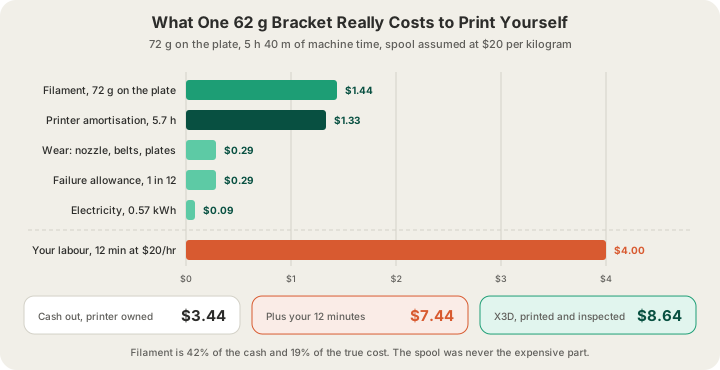
Two things jump out of that chart. First, the plastic is the smallest meaningful line once you own a machine: the printer costs more per hour than the filament it is melting. Second, the largest single line is your own twelve minutes — loading the file, clearing the plate, snapping off supports, cleaning up the scar they leave. That is the line most people zero out, which is exactly why home-print cost estimates come in so low.
Why Spool-to-Spool Comparisons Mislead Too
Even if you only care about filament cost per gram, the sticker price on two spools is rarely comparable. Four things move underneath it, and none of them are printed in a font you can read from a listing photo.
| Sticker detail | What it does to cost per print | How to correct for it |
|---|---|---|
| Net weight | A 750 g roll priced like a 1 kg roll is 33% more per gram | Divide by net filament grams, never by the spool |
| Diameter tolerance | A slicer assumes 1.75 mm. Stock running 1.78 mm extrudes about 3.4% more plastic per millimetre and over-extrudes visibly | Pay for tighter tolerance on dimensional parts |
| Density | Price per gram is not price per cubic centimetre. PLA at 1.26 g/cm3 is one of the denser filaments, so a kilogram makes a smaller object | Compare grams if you are billed by weight, volume if the part size is fixed |
| Packaging and moisture | A wet spool wastes whole prints before it wastes filament | Buy sealed with desiccant, then dry it anyway |
The tolerance row is worth the arithmetic. Extrusion is a volume calculation: the slicer works out how much filament to pull based on a nominal 1.75 mm diameter, so filament actually running at 1.78 mm delivers the square of the ratio, about 3.4% more plastic, on every millimetre of every line. On a 72 g plate that is roughly 2.5 g of unplanned material and a wall that is visibly proud. Wet filament is the same kind of hidden tax paid in failures rather than grams — Drying Filament: Why We Do It and When You Should Care covers what moisture does on the way out of the nozzle.
What You Are Actually Billed For Here
Our rate is all-in per gram: $0.12 for PLA and PETG, $0.15 for ABS and ASA, $0.20 TPU. All-in means the number already covers the filament and the normal machine time together, so there is no second invoice for hours. Critically, the grams we count are the grams that leave the nozzle on your plate — the part, its supports, its brim, its purge. Billable weight rounds up to the whole gram, and there is a $1.00 minimum per part. Full rates live on /pricing.
Where that number comes from matters as much as what it is. We do not estimate from a bounding box. Upload an STL or 3MF at /print and we run a real OrcaSlicer slice of your model to measure it; upload an already-sliced .gcode.3mf and we quote the figures your slicer measured, with nothing re-derived — How to Export G-code From Bambu Studio (.gcode.3mf) walks through producing one. OBJ, STEP and a bare .gcode are not accepted, so convert to STL before uploading. Files cap at 100 MB for STL and 40 MB for any 3MF, sliced or not, and everything has to fit the 340 x 320 x 340 mm build volume of an H2S.
One thing sits outside the per-gram rate, and it is hours rather than grams. Premium 0.1 mm layers price at 1.75x, because halving the layer height roughly doubles the time on the machine without adding a gram — that same 72 g bracket is $15.12 at 0.1 mm against $8.64 at 0.2 mm, and 3D Printing Layer Height Explained: 0.08 vs 0.2 vs 0.28 covers when the finish is worth it. Colour changes the rate itself rather than adding a line. A plain STL prints in the one filament you choose; a colour project or a plate you sliced yourself is billed from the measured grams and hours of its colour slice, which already count every purge and tool change, at +$0.03/g for two colours and +$0.02/g for each colour after (PLA $0.15, $0.17 and $0.19 for two, three and four). The only colour charge outside the per-gram rate is the $25 second-AMS fee, once per order line, at five to eight colours.
Four Levers That Actually Move the Number
Because the price is grams, the levers are grams. Here is the same 62 g bracket after each one, in the order of how much they pay:
- Reorient the part so supports never generate. Nine grams of scaffolding vanish and so does the sanding afterwards. 3D Print Orientation for Strength: How to Orient a Model covers doing this without weakening the part in the process.
- Drop infill to what the load actually needs. Going from 25% to 15% takes this bracket from 62 g to 51 g without touching its outside dimensions. 3D Printing Infill Explained: Patterns, Density, and Cost shows what each density band buys.
- Hollow anything large and solid. Above roughly fist size, interior volume dominates weight, and weight is the invoice.
- Batch. Bulk pricing is 5% off at 5 units and 10% off at 10, plus a single plate shares brim, purge and one shipping charge across every part on it.
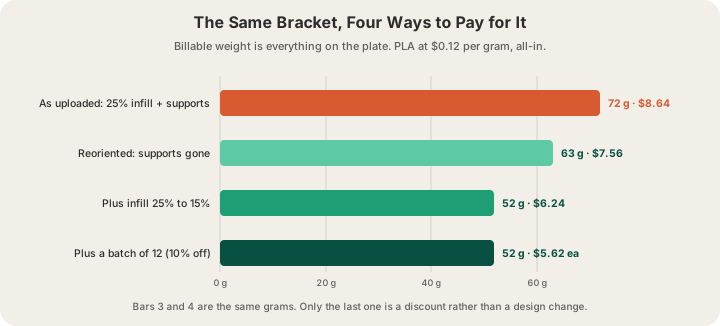
That is $8.64 down to $5.62 a unit, and a batch of twelve comes to $67.39 — which clears the $49.50 threshold, so the shipping goes to zero as well. Nothing about the bracket changed. The only thing that changed is how many grams had to exist for it to arrive.
FAQ
How much does 3D printer filament cost per print?
More than the finished part's weight suggests, always. Add support material, brim and prime line, and any colour-change purge, and a 62 g object routinely puts 72 g or more through the nozzle: $1.44 of plastic at $20/kg, not $1.24. The only way to know your number is to slice the actual file; the slicer reports the total filament for the plate, not the mass of the model.
Is it cheaper to buy a printer or use a print service?
It depends entirely on volume and on what your time is worth. In the worked example above, an already-owned printer produces the bracket for $3.44 in cash and $7.44 including twelve minutes of your labour, against $8.64 to have it printed and inspected. Buy a machine if you print constantly and enjoy the process. Order the part if you need three of them by Thursday.
Why is my slicer's cost estimate lower than what I actually spend?
Because the slicer only knows the filament on this plate at the price you typed in. It has no idea about your failure rate, the machine's purchase price amortised over its life, the electricity, the nozzle you replace, or the partial spools on your shelf. The slicer estimate is the material floor for one successful attempt, and it is honest about being exactly that.
Does a cheaper spool actually save money?
Only if it prints as reliably. Filament is under half the cash cost of a print and under a fifth of the true cost, so a 20% saving on the spool moves the bracket by about 29 cents. One extra failed plate costs $3.15. Loose diameter tolerance and wet packaging both raise failure rates, which means cheap filament can very easily be the more expensive filament.
Price it now
What would yours cost?
A real example, priced from our India rates: a 50 g PLA part comes to ₹400 printed, plus ₹79 delivery in India. Change the weight, material or quantity below and the price follows.
- 50 g × ₹8/g, per part
- ₹400
- Delivery
- ₹79
An estimate from the weight you entered. The real quote weighs your file.
Two ways to your real price
Have a file?
Upload it. See the exact price.
Drop in your STL or 3MF. We slice it and price the grams it really uses, in rupees. No account needed to see it.
Only an idea?
Describe it. We’ll email you a price.
No file, no problem. A few words on what it is and how big is plenty to start.
Or write to contact@x3dstudios.com