3D Printing API: Manufacturing as Code
A 3D printing API lets software order physical parts: POST a model file and a shipping address to an endpoint, get back an order code and a price, and a few days later a manufactured part arrives — no quote requests, no email threads, no human in the quoting loop. It does for manufacturing what Stripe did for payments and AWS did for servers: it turns a capital-intensive capability into an HTTP call. X3D's is live and self-serve, documented at /docs/api.
A 3D Printing API Makes Manufacturing Infrastructure
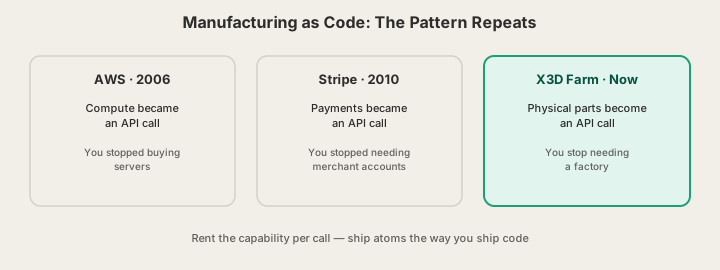
Before AWS, launching software meant buying servers. Before Stripe, accepting a credit card meant a merchant account and weeks of paperwork. Each time, an entire capability collapsed into an API key, and a generation of companies got built on top. Manufacturing is one of the last major capabilities still gated behind human quoting, phone calls, and factory relationships. A print farm behind a REST API removes that gate.
The consequences follow the same script, too. When servers became rentable per hour, thousands of products launched that never could have justified a data center. When manufacturing becomes callable per part, products launch that never could have justified tooling — a run of 25 brackets, a one-off robot gripper, a personalized product line with a customer base of 400 people.
Who Actually Needs This
"Software ordering parts" sounds abstract until you look at who is already forcing spreadsheets and email threads to do this job today:
- Hardware startups running CI for physical parts — merge a CAD change and the pipeline orders the new revision, like a nightly build that ships a bracket.
- Marketplaces and apps selling custom or personalized products without owning a single machine — a print on demand API is their fulfillment layer, shipped straight to their customer.
- Robotics teams and labs that break parts constantly: a gripper finger snaps at 2 a.m. and a script has already reordered it before standup.
- AI agents — an agent that designs a part can order its own prototype through the same API, or through X3D's MCP server, and iterate on what comes back.
What the API Does
Submit, Price and Pay in One Call
You POST a model file — STL, GLB or 3MF, or an already-sliced .gcode.3mf — as multipart form data, with the recipient's address and the material, colour and quantity. X3D measures the model, prices it at the per-gram rate, charges the card on your account and returns an order code in the same response: no callback, no salesperson, no "we'll get back to you within 3 business days." Every field is listed at /docs/api/submit-order, and the whole surface is also published as an OpenAPI description at https://x3dstudios.com/openapi.json.
curl -X POST https://x3dstudios.com/api/print/orders \
  -H "Authorization: Bearer $X3D_API_KEY" \
  -F "file=@bracket-v42.stl" \
  -F "material=petg" -F "color=Black" -F "quantity=25" \
  -F "recipientName=Ada Lovelace" \
  -F "street1=1100 Congress Ave" \
  -F "city=Austin" -F "state=TX" -F "zip=78701" -F "country=US"

# 201 Created
# { "code": "X3D-ABCD2345", "status": "RECEIVED", "paid": true, ... }Track by Polling
From there the order moves through received, printing, printed, shipped and delivered. Your program follows it by polling GET /api/print/orders/{code} with the same key; X3D does not push webhooks, and an order carries no callback URL. Physical stages take hours, so a poll every few minutes is as good as a push, and the people on the order are emailed at each stage anyway, with the tracking number in the shipped email. /docs/api/order-status lists every field.
Why Print Farms Make This Possible
Traditional job shops can't offer this because quoting requires human judgment: setup, tooling, machining strategy. A print farm is closer to deterministic. Price is a function of weight, material, and quantity — $0.12 per gram of PLA all-in, with a $1.00 minimum per part. A person still looks at every part before it is packed, and a print that comes out wrong is printed again rather than shipped, but none of that sits in front of the quote.
| Traditional job shop | API-driven print farm | |
|---|---|---|
| Quote | 1–5 days, human-generated | Instant, computed |
| Minimum order | $100+ setup fees | $1.00 per part |
| Placing an order | Email thread and a PO | One POST request |
| Status updates | Call and ask | A GET you can poll |
| Scaling 10x | Renegotiate the contract | Change the quantity field |
The economics compound with quantity, too: the same request that orders 1 part orders 50, the volume discount applies automatically — 5% off from 5 units and 10% off from 10 — and jobs spread across the fleet instead of waiting on a single machine. API orders print at Normal print speed, which ships in 4–5 business days; /farm shows the live lead time for 10, 100 and 1,000 orders.
X3D's Print API Today
The API is live and self-serve: sign in, put a card on file at /profile, and press Generate key. There is no waitlist and no approval step. Orders print on our own Bambu Lab H2S and P2S machines in Austin, Texas, and ship from there — $7 standard in the US, free over $49.50, or to 23 countries abroad. The surface is deliberately small: submit an order, read an order, manage your key.
If you would rather not write any HTTP at all, the same service is an MCP server at https://x3dstudios.com/api/mcp. Point Claude, Cursor or any MCP client at it and the agent can quote a model, place an order and track it as tool calls. Ordering there is two steps on purpose: a quote id, then an explicit confirm. Setup is at /docs/api/mcp.
The Agentic Future
Here's where it gets interesting. Our AI generator already turns a text prompt into a checked, print-ready model — a Fast Draft takes about half a minute. Put that beside a print API and the loop closes: an agent designs a part, orders it, measures what arrives, and orders revision two. Design and manufacturing both become steps in a program. When software can ship atoms, "hardware iteration speed" starts to look like software iteration speed — and the teams who wire this up first will simply out-cycle everyone else.
This isn't speculative infrastructure hunting for a use case. Agent frameworks already browse, code, and buy things; a documented endpoint that accepts a mesh and returns a tracking number is all that's missing for them to build in the physical world.
FAQ
What is a 3D printing API?
A REST interface for ordering physical parts programmatically: submit a 3D file and an address, get an order code and a price, and follow the order's status until a tracking number appears. Manufacturing without a human quoting step.
How much does printing through the API cost?
Same pricing as the rest of the site: $0.12 per gram all-in for PLA and PETG, $0.15 for ABS and ASA and $0.20 for TPU, with a $1.00 minimum per part, 5% off from 5 units and 10% off from 10. US shipping is $7 standard, free over $49.50, or $15 express. /docs/pricing has the full rate card.
What materials are supported?
PLA, PETG, ABS, ASA, and TPU — specified per order in the material field, covering rigid, outdoor-rated, and flexible parts. /docs/materials compares them.
Does the API send webhooks?
No. Poll GET /api/print/orders/{code} for status and tracking. The people on the order are emailed at every stage, and the shipped email carries the tracking number.
Is the API publicly available?
Yes. Keys are self-serve from /profile once a card is on file, with no waitlist. The reference is at /docs/api, and an AI agent can use the same service through the MCP server.
Price it now
What would yours cost?
A real example, priced from our India rates: a 50 g PLA part comes to ₹400 printed, plus ₹79 delivery in India. Change the weight, material or quantity below and the price follows.
- 50 g × ₹8/g, per part
- ₹400
- Delivery
- ₹79
An estimate from the weight you entered. The real quote weighs your file.
Two ways to your real price
Have a file?
Upload it. See the exact price.
Drop in your STL or 3MF. We slice it and price the grams it really uses, in rupees. No account needed to see it.
Only an idea?
Describe it. We’ll email you a price.
No file, no problem. A few words on what it is and how big is plenty to start.
Or write to contact@x3dstudios.com